



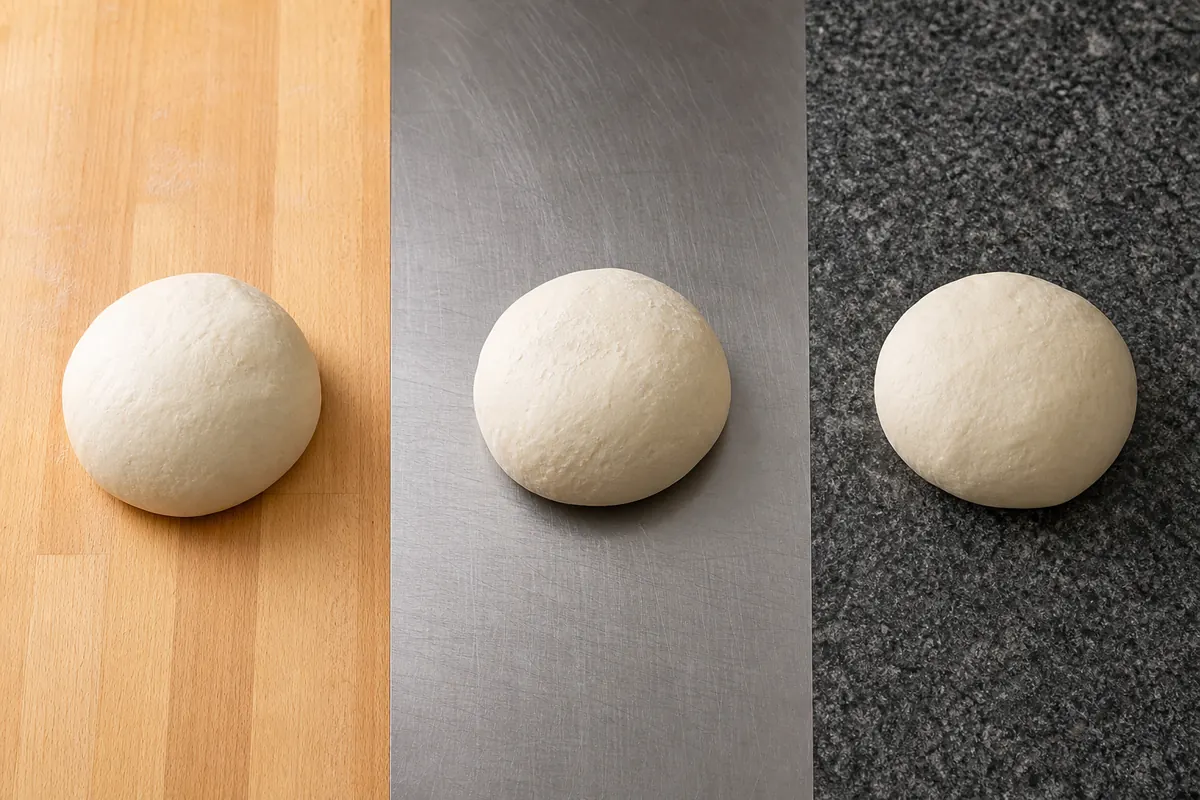
Wood, stainless steel, or granite — what do the pros use? This is one of the questions I get asked most often in workshops. The honest answer: There isn’t one single right work surface for pizza dough — it depends on where and how you bake. In my years as a pizzaiolo, I’ve tried just about everything in practice: workshops indoors in Teesdorf, outdoor catering in the summer, ambitious home kitchen setups. Each material has shown its moments — and its limits. Honestly, what surprised me most was how much a single situation — summer outdoors, pure sunshine — can completely turn the material question on its head.
In this article, I compare wood, stainless steel, granite, and marble honestly and without sugarcoating — based on the four criteria that really count for pizza dough. And I’ll tell you about a practical tip you won’t find in most other comparisons: what happens when stainless steel is left out in the sun. Spoiler: You don’t want to experience that.
What really matters for a pizza dough work surface
Before we dive into the materials, a quick look at the four criteria I use to evaluate everything here. Not every kitchen surface is automatically suitable for pizza dough.
Temperature: A cool surface slows down the yeast and prevents the dough from rising and becoming stickier during work. This makes a noticeable difference, especially with highly hydrated pizza dough. Smoothness: A smooth surface means the dough doesn’t stick and separates cleanly from the dough balls when opening, without tearing. Hygiene: Pizza dough with yeast reacts to impurities — the work surface must be thoroughly and easily cleanable. Stability: A surface that shifts while kneading turns all dough work into an effort. This sounds trivial, but it makes a huge difference in practice.
Wood — the classic with a surprising strength
Wood is the oldest material in the bakery and has its place — but not necessarily where you might expect it. For traditional dough work like shortcrust pastry, bread, or cookies, a good solid wood board is still the first choice. For pizza dough, especially with higher hydration, it’s more nuanced.
The biggest problem with wood for pizza dough: it absorbs moisture. With dough at 65% hydration or more, the dough sticks to wood faster than to stainless steel or granite. You need more dusting, which in turn dries out the dough surface. Wood is also not entirely unproblematic in terms of hygiene — it lives, can develop cracks, and if you store the board too damp, you risk mold. It definitely doesn’t belong in the dishwasher. With solid wood, you can at least sand down cracks and scratches — that’s a real advantage over coated alternatives.
But where wood clearly has the upper hand is for outdoor use — and that’s a point hardly any other comparison article mentions.
I quickly noticed this during my summer catering jobs: a stainless steel kneading board in direct sunlight gets so hot that the dough immediately starts to stick and the fermentation goes completely out of control. The wooden board, on the other hand, stays significantly cooler in the sun — and that’s the decisive advantage for outdoor use that no indoor comparison shows you.
Klausi, Workshops Teesdorf & Outdoor Catering
Care tip for wooden boards: Wipe dry after use, rub regularly with linseed oil or beeswax. Sand down once a year if scratches and grooves have accumulated. Then a good board will last for decades.
Wood is best for: Outdoor catering and garden pizza in summer, traditional doughs (shortcrust, bread), pizza dough up to ~65% hydration, those who value a natural atmosphere.
Stainless steel — the pizzaiolo standard for the home kitchen
If you look into a well-equipped pizzeria kitchen, you’ll see stainless steel — on work surfaces, cooling tables, and shelves. There’s a reason for that: stainless steel is cool, smooth, hygienic, and can be cleaned in seconds. For pizza dough in the home kitchen, it’s a hard-to-beat combination.
Dough sticks significantly less to stainless steel than to wood. The smooth, non-porous surface doesn’t absorb odors or fats — a damp cloth is enough after working the dough. Good stainless steel (AISI 304) is food-safe, so you don’t have to worry about that. Especially with highly hydrated doughs — from 70% water content — stainless steel is the best material you can get in a home kitchen without installing a complete granite countertop.
The honest weaknesses: outdoors in direct sun, stainless steel heats up a lot — we already covered this in the wood comparison above. Not an issue in the home kitchen, but a real problem outdoors in the summer. Over time, scratches appear, which are visually annoying but don’t affect functionality. And: on smooth kitchen countertops, a stainless steel kneading board will slide away without a mat — more on that shortly.
The smart solution for the home kitchen is the kneading board as a cover: no kitchen renovation, flexible to use, simply put away after use. For 2–4 dough balls — i.e., the normal pizza night for family or friends — the Pizza Kneading Board 59×46 cm is the perfect everyday companion. If you need more output — workshops, larger groups, ambitious family pizza setups — the large kneading board 79.5×46 cm will satisfy your needs: it has space for six or more dough balls at once.


If your dough still sticks despite the stainless steel surface, it’s usually not the material — temperature, hydration, and dusting play a bigger role. You can find out more here: More about sticky pizza dough and how to prevent it →
Stainless steel is best for: Home kitchen year-round, ambitious hobby pizzaiolo, high hydration (65–80%+), indoor workshop setup.
Granite — what pizzeria pros use
Take a look at the cooling tables in a well-equipped pizzeria — almost all of them have granite tops. That’s not by chance. Polished granite stores cold and releases it slowly: it stays noticeably cooler than stainless steel and is simultaneously so smooth that dough can be opened perfectly — no sticking, no tearing.
Granite is also virtually indestructible: scratch-resistant, heat-resistant, durable. A well-impregnated granite surface lasts a lifetime and can be cleaned hygienically. That’s why granite is the professional standard in gastronomy — not marble, not stainless steel, but granite.
The downside is the investment. Granite is heavy and expensive — hardly available as a dedicated kneading board, and as a countertop material, it only makes real sense during renovation or new construction. In addition, the impregnation must be renewed regularly: if you neglect this, granite will absorb oil and become stained. Acid — tomato juice, lemon, vinegar — can permanently damage untreated areas. If you use the same surface for dough work and topping, you should keep this in mind.
Granite is best for: High-quality home kitchens during renovation or new construction, ambitious workshop setups, professional gastronomy — anywhere where the investment pays off in the long run.
Marble — beautiful, but second choice for pizza
Marble has its rightful place in patisserie: shortcrust pastry, chocolate, pralines — here the cool surface and smooth appearance are truly advantageous. However, for pizza dough, marble is the weaker option compared to granite, and for a specific reason.
Marble is sensitive to acid. Tomato juice, lemon, or vinegar leave dull spots on untreated marble and attack the surface — a real problem if you use the same surface for dough work and topping. Furthermore, marble is softer than granite: more susceptible to scratches and impacts, and not as robust in direct comparison.
If you already have a marble block: great, it works well for dough work. But if you’re buying new specifically for pizza, I would always prefer granite — more robust, acid-resistant, the better long-term decision.
Marble is best for: Patisserie, shortcrust pastry, chocolate work — clearly a second choice behind granite for pizza dough.
Klausi’s practical recommendations per setup
Here, in a nutshell, what really makes sense for each use case:
| Setup | Recommendation |
|---|---|
| Home kitchen, ambitious hobby pizzaiolo | Stainless steel kneading board as a cover (59×46 or 79.5×46 cm) |
| Outdoor / Summer / Catering | Wooden board — stays cooler in the sun than stainless steel |
| Workshop setup for multiple people | Large stainless steel kneading board 79.5×46 cm |
| Renovation / New construction, pizza is serious | Granite countertop |
| Patisserie + occasional pizza | Marble + place stainless steel kneading board on top if needed |
Kneading board as a pragmatist’s solution — when it makes sense
Few people want to renovate their entire kitchen for good pizza dough work. And they don’t have to. A stainless steel kneading board as a cover on the existing work surface gives you easily 90% of the effect of a permanently installed granite or stainless steel slab — flexible, mobile, and simply put away after use.
Regarding size selection: The 59×46 cm kneading board is the everyday companion for 2–4 dough balls — fits on any standard kitchen counter, is easy to transport, and also suitable for outdoor excursions (in the shade!). The large 79.5×46 cm kneading board is built for serious use: six or more dough balls at once, workshop quantities, when the whole family joins in, or when you go all out for guests. This is also the board I use in my workshops in Teesdorf.
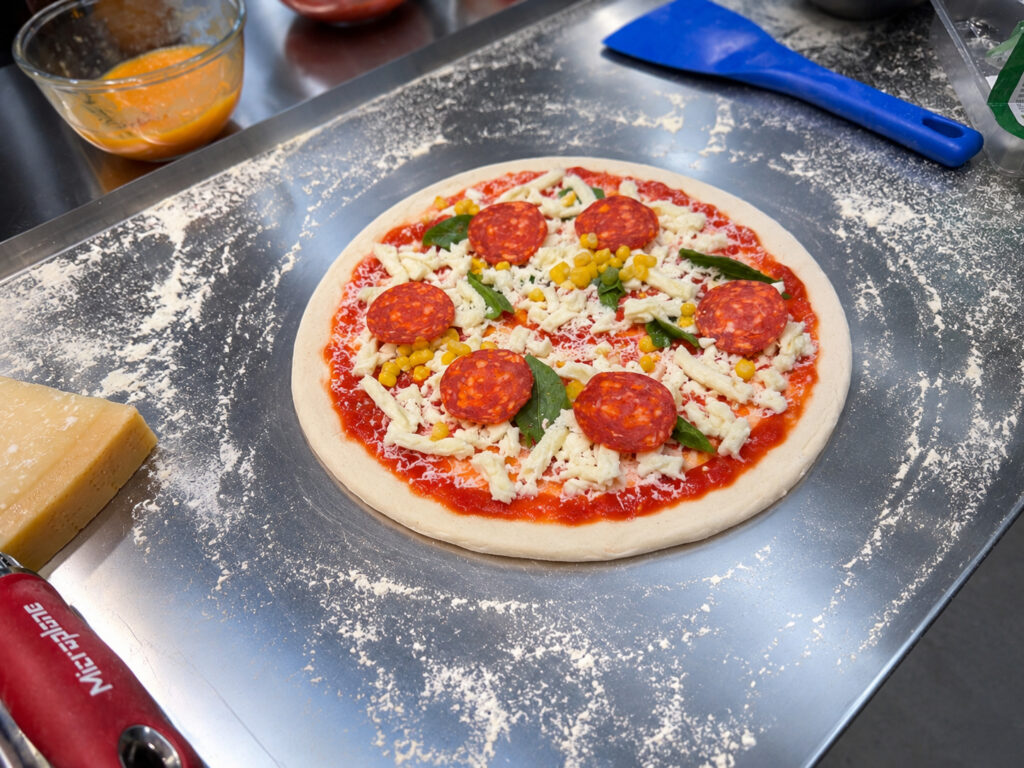
One point that is often underestimated and is huge in practice:
Without an anti-slip mat under the kneading board, dough work on smooth kitchen countertops is a real struggle. The board shifts away, you work against it — and the whole exercise costs twice as much effort. The HENDI anti-slip mat is the cheapest upgrade for your entire setup.
Klausi, PizzaStunde
The HENDI anti-slip mat ensures that the kneading board sits firmly on ceramic, laminate, granite, or stone countertops and does not shift. It is food-safe, easy to clean, and fits under both kneading board sizes. Sounds like a small thing — but it makes a noticeable difference in practice with every dough work.
Frequently asked questions about the work surface for pizza dough
Which work surface is best for kneading pizza dough?
For the home kitchen, stainless steel is the sweet spot: cool, smooth, hygienic, easy to clean, and ideal for high hydration. Professionals in gastronomy use granite because it stores cold and is polished smooth. Outdoors in summer, wood is the better choice — stainless steel heats up in direct sun and the dough promptly sticks.
Does pizza dough stick more to wood than to stainless steel?
Yes, generally it does. Wood absorbs moisture and has a slightly porous surface — both factors cause wetter pizza dough to adhere more than on smooth stainless steel. With sufficient dusting (Granito or Tipo 00), it works well. For high hydration doughs from 70% onwards, I would always prefer stainless steel or granite.
Why do pizzerias almost always use granite countertops?
Granite stores cold, is polished smooth, hygienically sealed, and virtually indestructible. Pizza cooling tables in gastronomy almost always have granite tops because the dough stays cool when opened and can be worked perfectly without sticking or tearing. The high investment pays for itself over decades in professional operation.
Do I need an anti-slip mat under the kneading board?
On smooth kitchen countertops made of ceramic, laminate, or polished stone: yes, almost always. A stainless steel kneading board quickly slides on these surfaces — and if the board moves with every kneading stroke, you’re fighting your own setup. A good anti-slip mat solves the problem completely and costs very little.
Is marble better than granite for pizza dough?
No. Granite is clearly the more robust choice. Marble is more sensitive to acids — tomato juice leaves dull spots on untreated marble and permanently damages the surface. Furthermore, marble is softer and more prone to scratches than granite. For pizza dough: granite beats marble in every practical test.
Conclusion
There is no perfect work surface for pizza dough — it depends on where and how you work. For the home kitchen, a stainless steel kneading board is the pragmatic all-rounder: cool, smooth, hygienic, and in terms of results, hardly worse than a permanently installed granite countertop — but without the complete kitchen renovation. Outdoors in summer, it’s better to leave the stainless steel board at home and take the wooden board with you.
Don’t want to miss any new tips, recipes, and workshop dates? Then sign up for the newsletter — fresh in your inbox every Thursday.
