



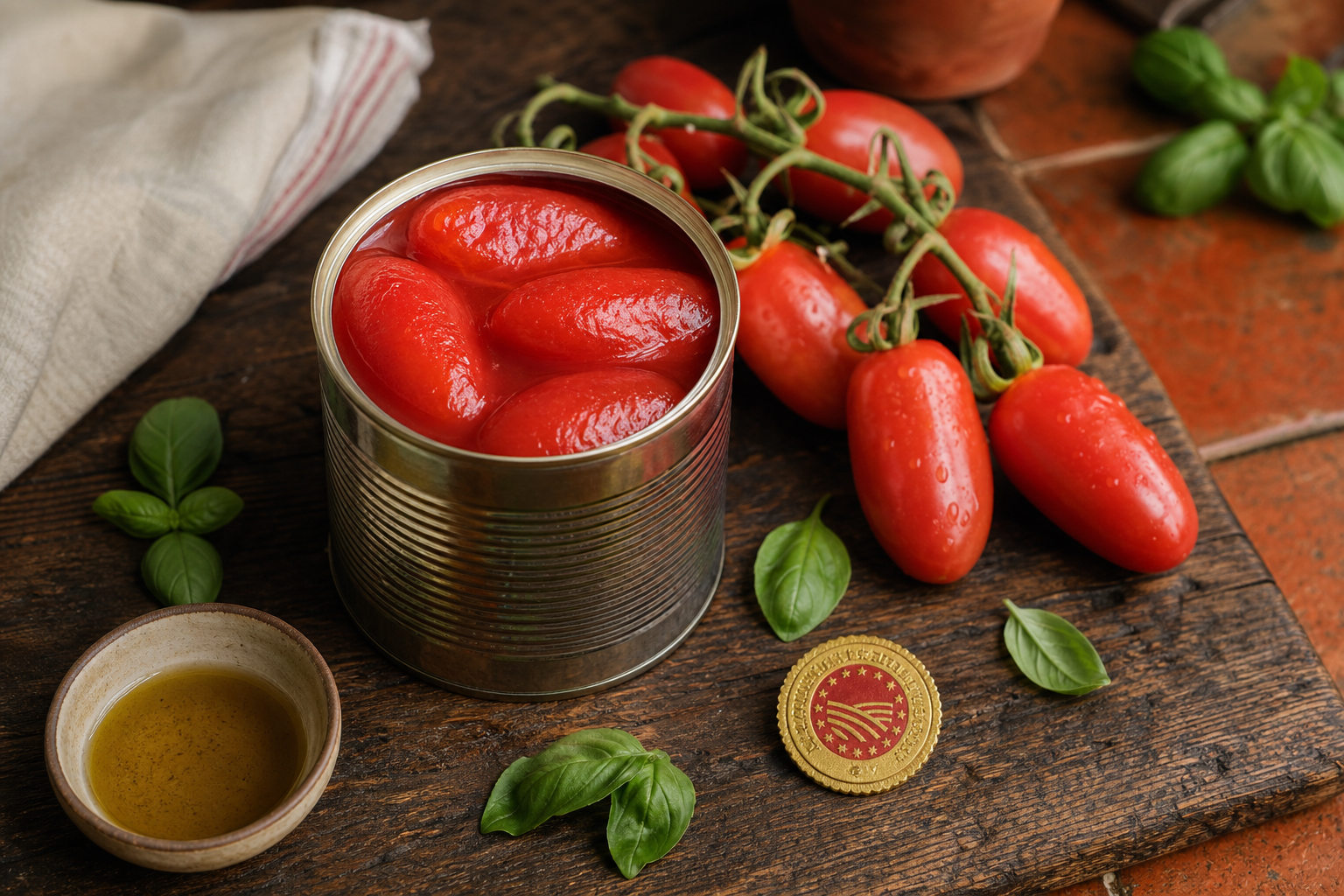
You reach for a can of San Marzano DOP tomatoes and wonder what this abbreviation actually means? Or you see “IGP” on pasta and don’t know exactly what the difference is to “DOP”? You’re not alone – and the difference is greater than you might think.
Short answer: Yes, absolutely. And once you understand why, you’ll never look at ingredients – or drinks – the same way again.
What does DOP mean?
DOP stands for “Denominazione di Origine Protetta” – in German: protected designation of origin, or g.U. for short. The EU-wide equivalent is PDO (Protected Designation of Origin), or AOP (Appellation d’Origine Protégée) in French. All three abbreviations mean the same level of protection.
The DOP/g.U. seal means: the raw material and processing must come from a clearly defined geographical region. Both. Without exception. Not a single step can be outsourced – from sowing to harvesting to the finished product.
What does IGP mean?
IGP stands for “Indicazione Geografica Protetta” – protected geographical indication, or g.g.A. for short. EU English: PGI, French: IGP. At least one step of the production – meaning either cultivation, processing, or production – must come from the named area. The raw materials may come from elsewhere, as long as the production takes place in the region. This doesn’t make IGP worse, but it is less strict than DOP.
The core difference at a glance
| DOP / g.U. / AOP | IGP / g.g.A. | |
|---|---|---|
| Raw material from the region | ✅ Mandatory | Optional |
| Processing in the region | ✅ Mandatory | Optional (at least 1 step) |
| Strictness | Very high | Medium |
| Well-known examples | Champagne AOP, Bordeaux AOP, San Marzano DOP, Parmigiano Reggiano DOP | Pasta di Gragnano IGP, Aceto Balsamico di Modena IGP, Speck Alto Adige IGP |
Well-known examples – from France to Italy
By the way, the principle is not purely Italian. The best-known examples of protected designations of origin actually come from France – and you definitely know both of them.
Champagne AOP – arguably the most famous g.U. product in the world
Sparkling, festive, expensive – and rightly protected. Champagne can only call itself Champagne if it comes from the region of the same name in northeastern France. Grape cultivation, pressing, fermentation, the second fermentation in the bottle (méthode champenoise), aging – everything takes place exclusively in Champagne.
Sparkling wine from Spain is called Cava. From Italy, Prosecco (IGP, by the way) or Franciacorta (DOP). From Germany, Sekt. All great products – but none of them are Champagne. EU law has protected this name for decades, and the dispute over the designation has a long history: France fought this battle early and consistently.
Bordeaux AOP – when the place defines the wine
Bordeaux is arguably the most famous wine region in the world – and the AOP seal protects not only the name but also the grape varieties, cultivation methods, and minimum quality standards. A Cabernet Sauvignon from Chile might be made in the Bordeaux style and taste excellent – but it cannot call itself Bordeaux.
This is the same idea as with San Marzano: origin is a characteristic of the product, not a marketing claim.
Parmigiano Reggiano DOP
The king of hard cheeses. Parmigiano Reggiano can only be produced in a strictly defined area in Emilia-Romagna – Parma, Reggio Emilia, Modena, Bologna, and Mantua. The cows must be kept in the region, the feed must largely come from there, and the aging (at least 12 months) also takes place there.
What many don’t know: The name “Parmesan” is a protected term in the EU and can only be used for genuine Parmigiano Reggiano DOP. Everything else is hard cheese – but not Parmesan.
Mozzarella di Bufala Campana DOP
Buffalo mozzarella from Campania – one of Italy’s most famous DOP products. The milk must come from water buffaloes from a clearly defined area in Campania, Lazio, and Molise. And of course, it is processed there too.
The difference to normal mozzarella made from cow’s milk is noticeable not only in taste (creamier, slightly acidic, more intense) but also legally clear: only the genuine buffalo version with proof of origin can be called “Mozzarella di Bufala Campana DOP”.
Pasta di Gragnano IGP – a great example of the IGP concept
Gragnano is a small town in the province of Naples – and has been the center of Neapolitan pasta culture for centuries. Pasta di Gragnano has carried the IGP seal since 2013.
Why IGP and not DOP? Because the wheat doesn’t necessarily have to come from the region – Gragnano simply doesn’t have enough agricultural land. But the production itself – pressing through bronze dies (trafilatura al bronzo), slow drying at low temperatures, and the special humidity of the coastal climate – all of this takes place exclusively in Gragnano. That makes the difference, and that’s what the IGP seal protects.
Aceto Balsamico: IGP vs. DOP on the same product
Here, the difference between IGP and DOP is particularly clear – because both seals exist for “Balsamic Vinegar of Modena”, but they refer to two very different products.
Aceto Balsamico di Modena IGP is what you buy in the supermarket: grape must and wine vinegar, produced in the Modena/Reggio Emilia region, with defined minimum standards. Good, versatile, affordable.
Aceto Balsamico Tradizionale di Modena DOP is a completely different world: exclusively concentrated grape must, aged for at least 12 years in a battery of different wooden barrels, no additives, no shortcuts. Small bottles, high prices – and a taste that defies all comparisons.
So both are “Balsamic Vinegar of Modena” – but the difference between IGP and DOP here reflects a difference in production philosophy that could hardly be greater.
San Marzano – DOP in practice
Back to the tomatoes. The San Marzano tomato is probably the best-known DOP product in the pizza world – and it demonstrates the difference between a genuine DOP product and a simple brand name like few other examples.
“San Marzano DOP” specifically means: the tomatoes must come from the Agro Sarnese-Nocerino – a small area south of Naples in the provinces of Salerno and Naples. Volcanic soil, a very special microclimate. Only here do these tomatoes grow as they should: meaty, low in acidity, aromatic. In addition, the processing must also take place in the same geographical area, controlled by the Consorzio San Marzano dell’Agro Sarnese-Nocerino.
By the way, we show you how to make a classic Italian pizza sauce from real San Marzano DOP tomatoes in our recipe for the perfect pizza sauce – simple, without cooking, as it’s done in Naples.
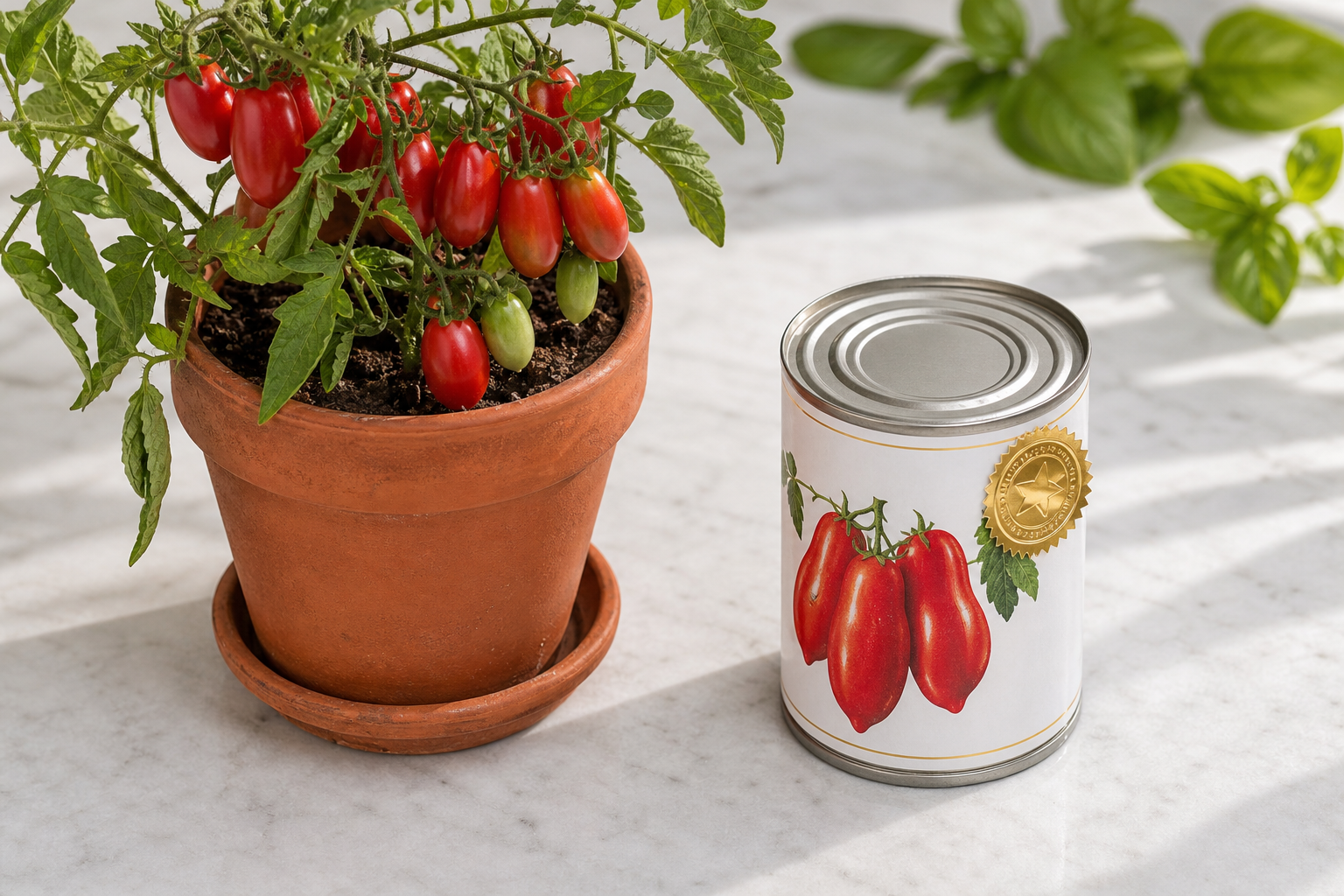
Homegrown San Marzano are not DOP – and that’s OK
Here lies one of the most common misconceptions: You plant San Marzano seeds in your garden, grow the tomatoes, harvest them in September – and still don’t have DOP tomatoes.
Why? Because DOP is not a variety designation, but a geographical designation of origin. The plant variety alone is not enough. You need the right volcanic soil, the microclimate in Campania, certified processing according to Consorzio specifications, and official control and seal issuance.
This applies equally to Champagne: you could press excellent sparkling wine in Styria with the same grape varieties and the same method – it still wouldn’t be allowed to call itself Champagne. And a hard cheese made from a Parmesan recipe from Tyrol is not Parmigiano Reggiano. Origin is not reproducible – that is the core idea behind the DOP system.
Tomatoes you grow at home in a pot on the terrace might be beautiful, delicious tomatoes. They just legally cannot be called “San Marzano DOP”. This is not a disadvantage of your homegrown tomatoes – it’s simply the logic of the system.
The real San Marzano DOP – my recommendations
If you want the original – for your pizza sauce, your sugo, or just straight from the can with good olive oil and sea salt – then these are my recommendations from the PizzaLaden:
La Carmela San Marzano DOP (400g)
Classic, reliable, sweet-aromatic. Low acidity, lots of flesh, few seeds. Perfect for a Margherita or a simple sugo where the tomato should play the main role.
Strianese San Marzano DOP (400g)
A bit more robust in flavor, with a more intense tomato note. Loyal fan base among home cooks who like their sauce a bit more rustic. Also excellent for Shakshuka or as a ragù base.
Both have the official DOP seal, both come from the Agro Sarnese-Nocerino – and both make a difference on the pizza that you can really taste.
Conclusion
DOP and IGP are not marketing buzzwords. They represent a European protection system that guarantees genuine origin and genuine quality standards – and that controls and enforces these standards.
DOP is the stricter of the two seals: raw material and processing, both from the region. This applies to Champagne as well as to San Marzano tomatoes or Parmigiano Reggiano. IGP protects at least one central production step in the region – which, as Pasta di Gragnano shows, can still represent a clearly superior product.
Whether Champagne, Bordeaux, Parmigiano Reggiano, or San Marzano DOP: When you work with, cook with, or enjoy these products, the sum of geography, tradition, and craftsmanship is behind it – this cannot be simply reproduced by any industrial mass product.
