



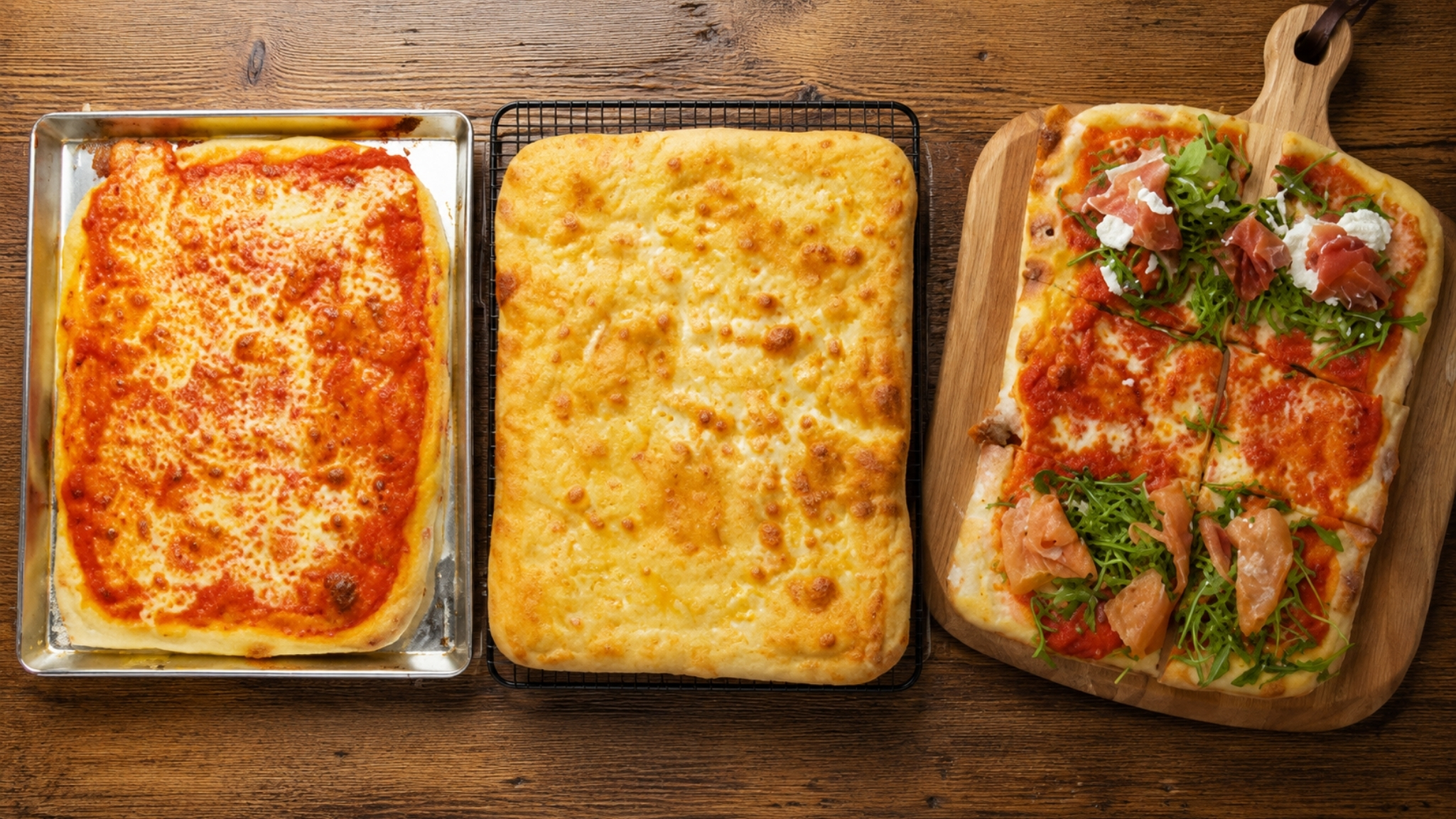
You want to bake focaccia, your buddy wants sheet pan pizza, and you actually feel like pizza al taglio with three different toppings? No problem – with a single dough you can make all three. Today I’ll show you exactly how.
Today we’re making focaccia, pizza in teglia, and pizza al taglio – all from the same dough with Caputo Aria at 75% hydration. And so you know what you’re actually baking, I’ll briefly explain the difference between the three variations. If you want to know how 75% compares to other hydration levels and what that actually changes in the dough, I break it down here.
Focaccia, Pizza in teglia & al taglio – what’s the actual difference?
Many people confuse pizza in teglia and pizza al taglio. Both are sheet pan pizzas – but not the same:
| Variation | What is it? | Special feature |
|---|---|---|
| Focaccia | Flat, airy bread from a baking sheet | More olive oil, press holes in, no classic pizza topping needed |
| Pizza in teglia | Sheet pan pizza, the whole pan is served as one unit | Baked with toppings – one pan, one topping |
| Pizza al taglio | Sheet pan pizza, which is cut into slices and sold by the slice | Different toppings per slice possible, traditionally with the double-bake method |
The crucial difference: With pizza al taglio, I first bake the dough *without* toppings, then add the toppings and bake again. This is called the double-bake method – and I swear by it because the cheese simply turns out much better this way and doesn’t burn before the base is cooked through.
The dough – one recipe for all three
For all three variations, I’m using 75% hydration today – a compromise. For a classic focaccia, I would normally go for 80-85%, but 75% works well for all three variations from the same dough.
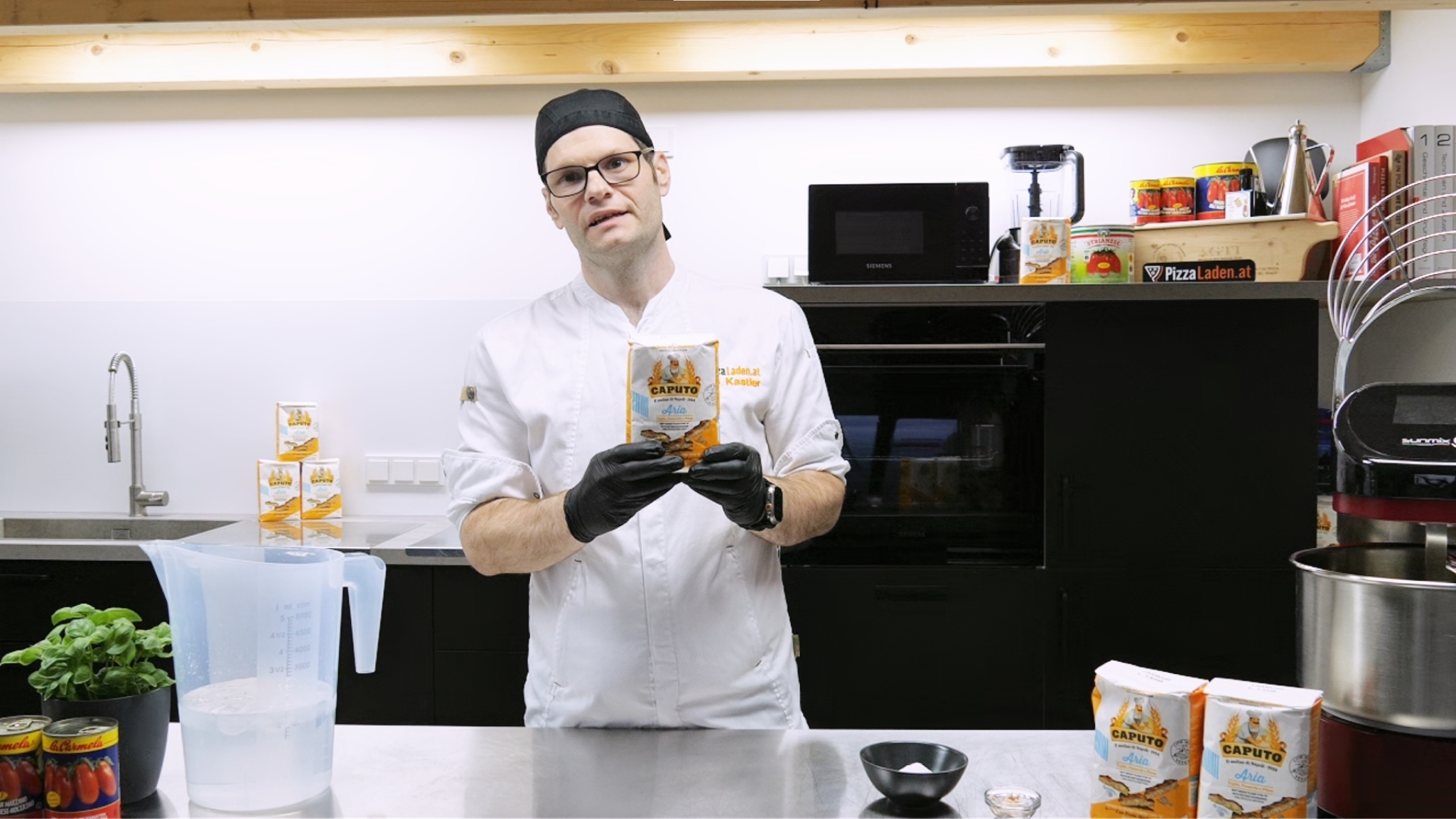
Ingredients (per 1 kg flour)
| Ingredient | Quantity per kg flour |
|---|---|
| Flour (Caputo Aria) | 1,000 g |
| Ice water | 750 g (= 75%) |
| Yeast (fresh) | 2 g |
| Fine sea salt | 25 g |
For 3 kg flour, multiply accordingly: 2,250 g water, 6 g yeast, 75 g salt.
Why Caputo Aria?
Caputo Aria is a strong flour with 13% protein – it was explicitly developed for this type of pizza. The special feature: It contains inactive sourdough. While it’s no longer active (so not a leavening agent), it gives the dough significantly more flavor. You can taste it, especially in focaccia and al taglio, where the dough itself plays the main role.
Preparing the dough – step by step
1. Weigh flour & prepare water
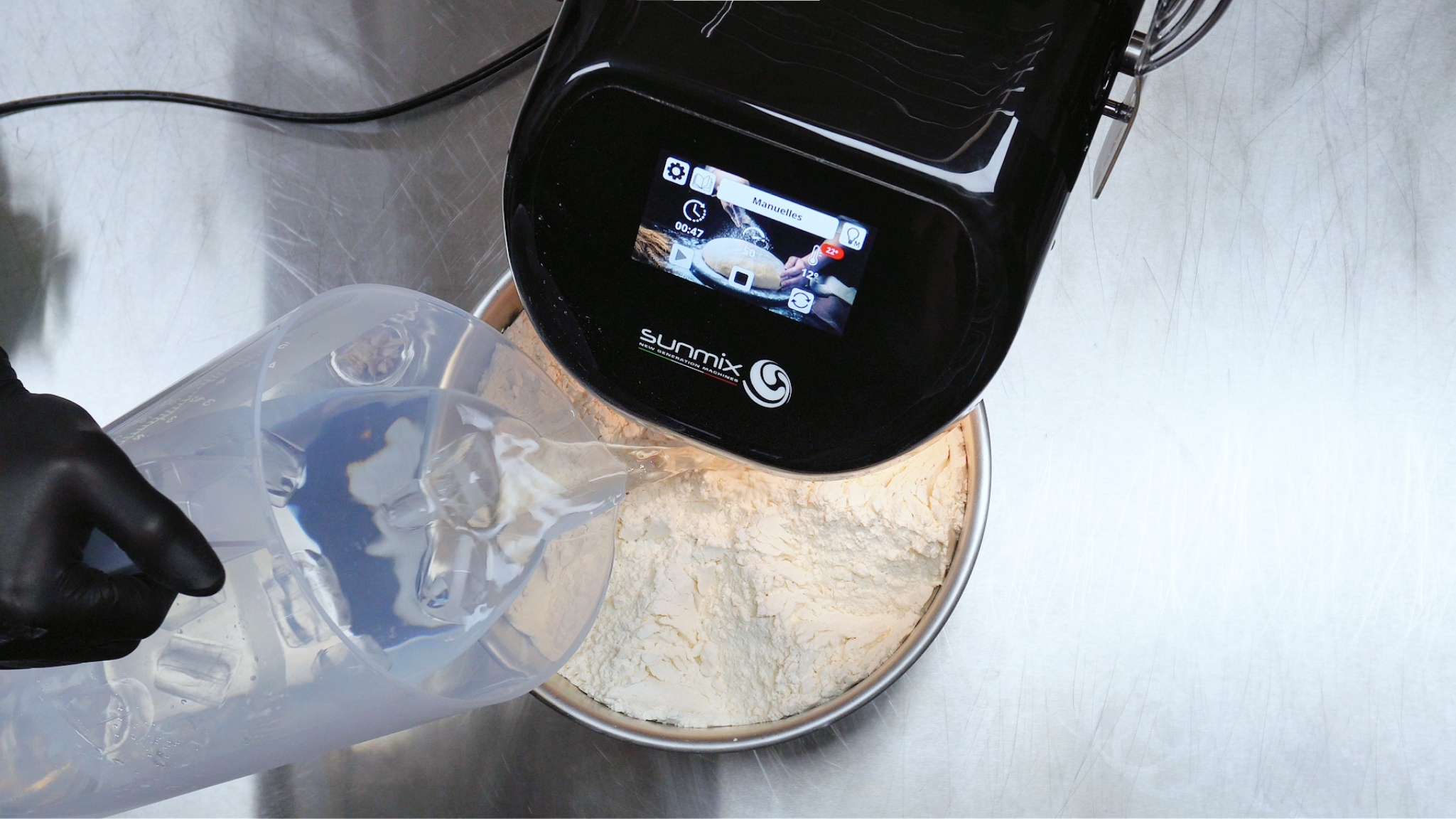
Put the flour in the kneading machine and mix briefly on the lowest setting (approx. 50 rpm) to dissolve any lumps. Then add approx. 80% of the ice water directly – save the rest for later.
2. Add yeast directly – no need to dissolve
Simply add the yeast directly to the dough – no dissolving in water needed. That’s a myth. The spiral hook of the Sunmix will incorporate it completely and evenly anyway. Increase speed to approx. 120 rpm now.
3. Salt & remaining water
As soon as the first gluten strand forms (you’ll see the dough starting to hold together), add the salt and the remaining water. Then increase to approx. 160 rpm and let it knead until the dough cleanly detaches from the bowl.
4. Don’t over-knead – better to take it out sooner
This is my most important tip: Better to take it out of the machine too early than too late. An over-kneaded dough will retract, become difficult to spread, and tough. If it detaches and looks smooth – take it out.
5. Stretch & Fold + Windowpane test
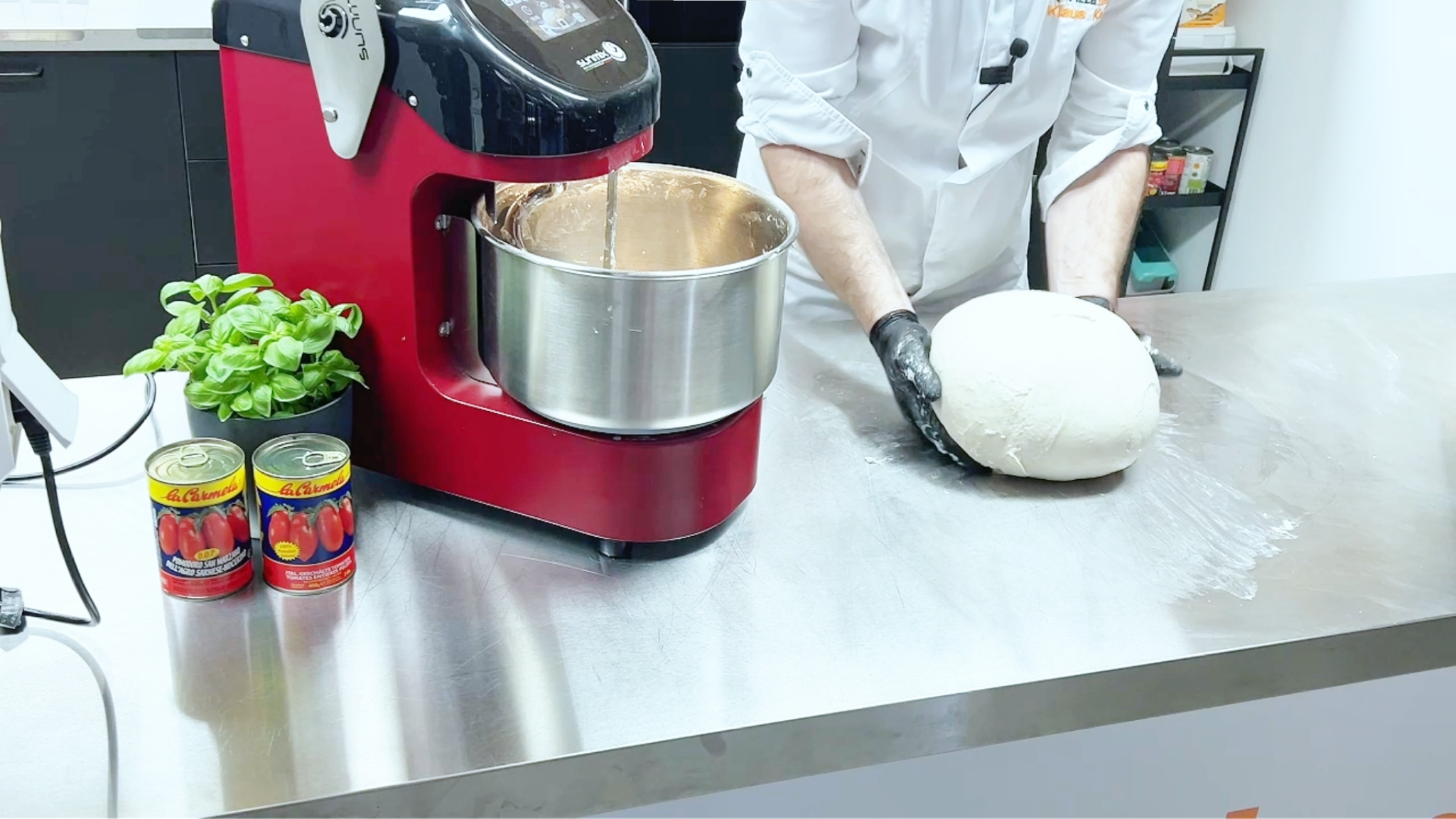
Put a little olive oil on the work surface, take out the dough, and do a few rounds of Stretch & Fold. Then the windowpane test: Carefully pull a piece of dough apart – if you can see through it without it tearing, the gluten structure is ready.
Dough portioning: Shape dough balls & refrigerate
Portion the dough: approx. 750 g per dough ball. Shape them slightly elongated – no perfect shaping needed, just roughly form them. Put them in the oiled dough ball containers.
- Let rest at room temperature for 1-2 hours (yeast activates)
- Then refrigerate overnight
- Prefer 10cm high dough ball containers over 7cm ones
- Maximum 72 hours – I wouldn’t go longer
💡 Tip for Focaccia: Prefer 800-850 g dough balls instead of 750 g, so you have enough volume for a thick result.
Baking Focaccia
Take the dough out of the refrigerator, gently spread it on a surface floured with semola – just press with your fingers from the inside out, no rolling pin. Then place it on the well-oiled focaccia pan.
- Let it rise at room temperature for at least another 1-3 hours, covered with a damp kitchen towel
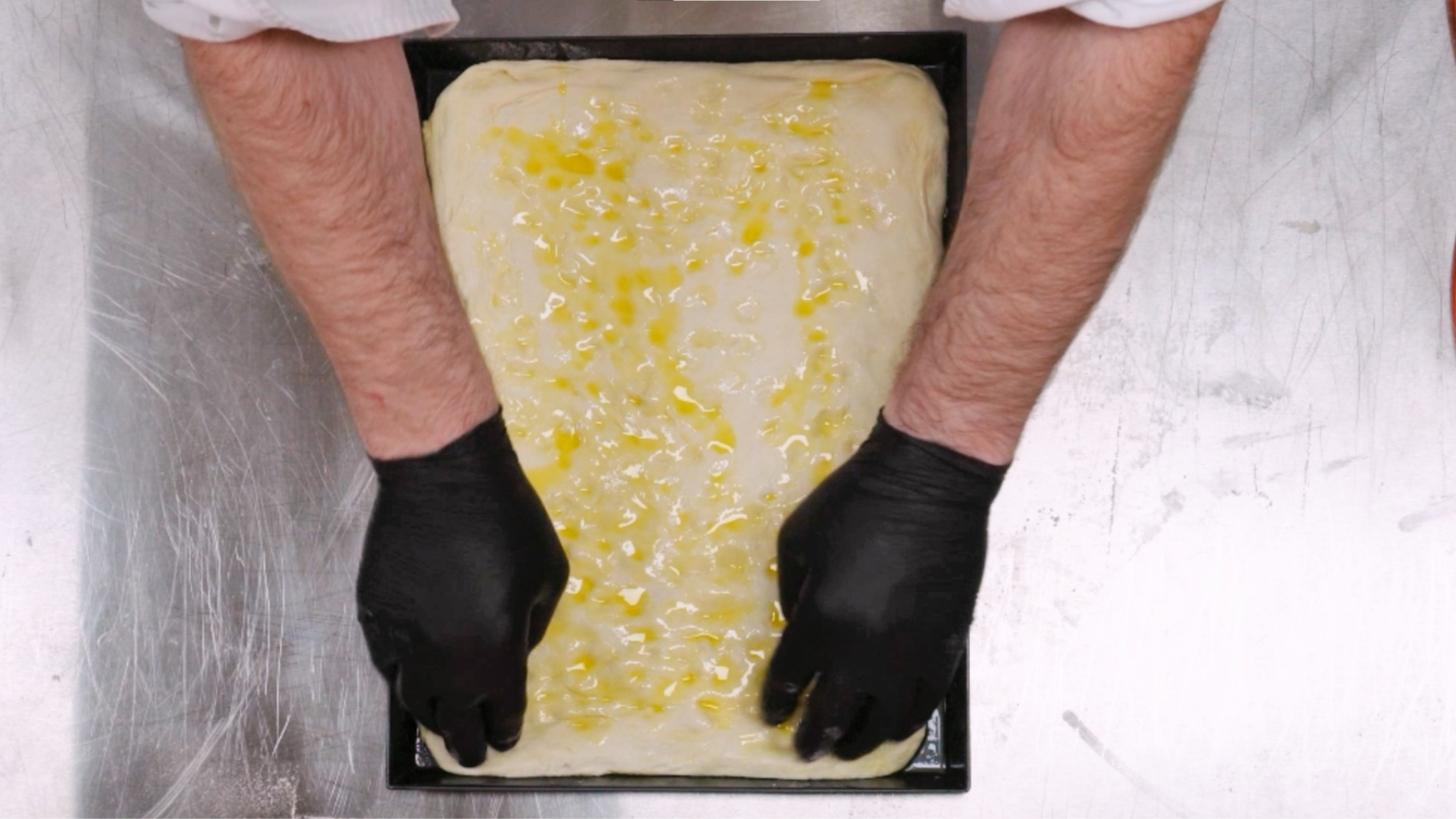
- Then generously drizzle with olive oil and press the typical holes with your fingers
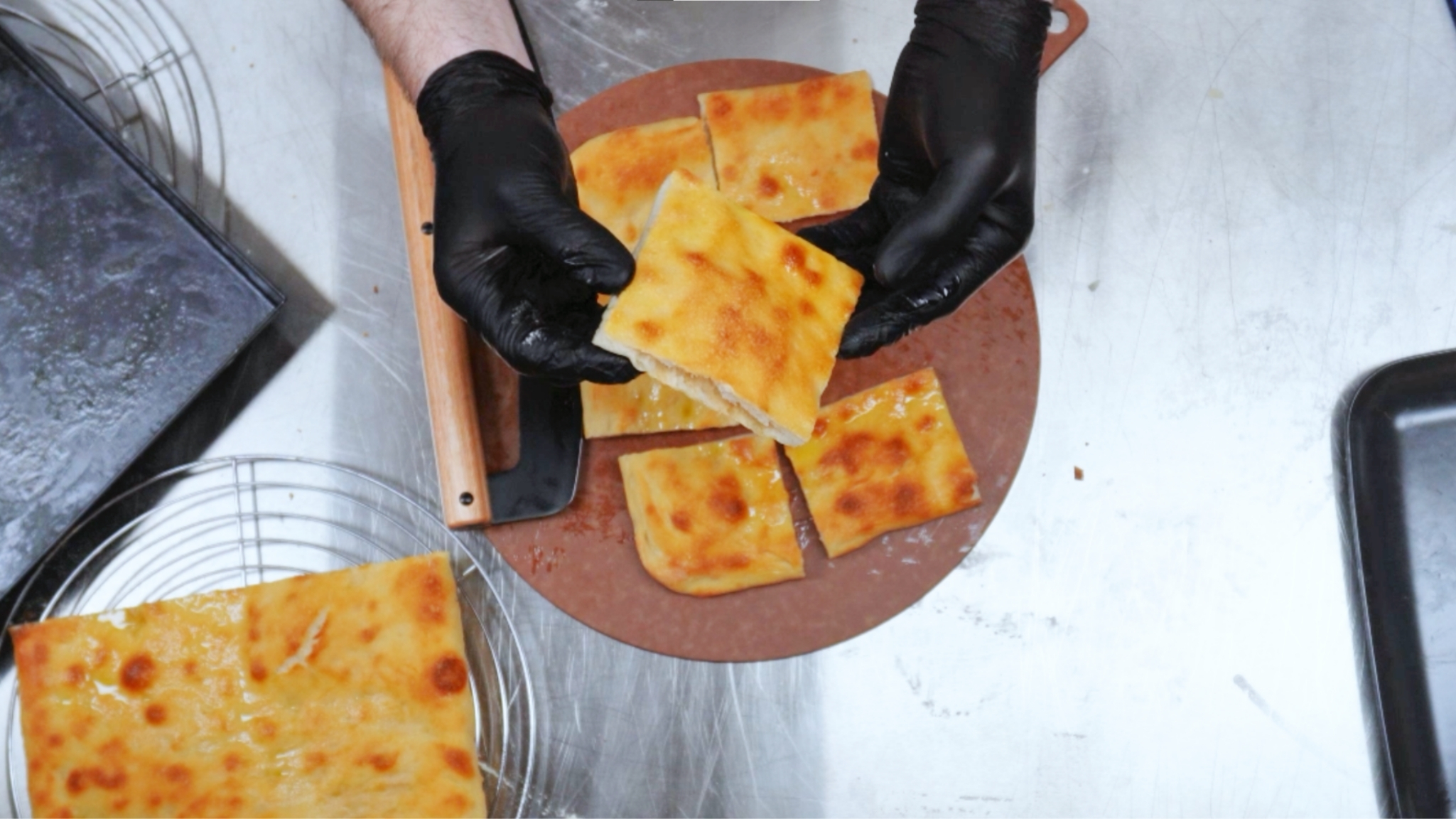
- Into the oven at 250 °C top/bottom heat, approx. 20 minutes
For even more volume: After spreading, let it rise for 2-3 hours at room temperature instead of just one. This makes the difference between flat and truly airy.
Baking Pizza in Teglia
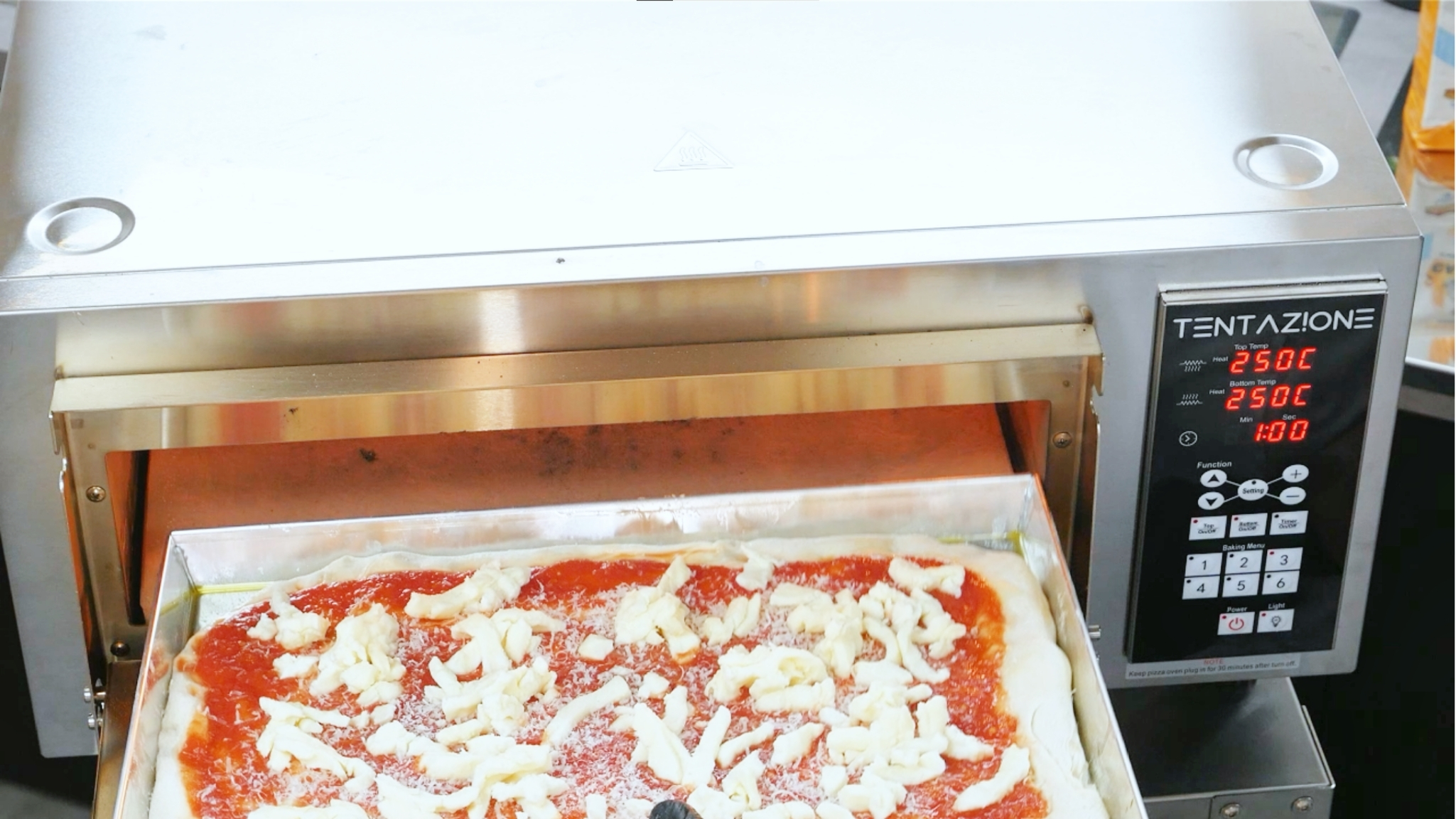
The pizza in teglia is baked with toppings directly – tomato sauce, cheese, toppings all on and into the preheated oven.
- Oil the aluminum pan well
- Gently spread the dough and place it on the pan
- Top completely: tomato sauce, mozzarella, desired toppings
- 250 °C top/bottom heat, approx. 20 minutes total time
- Parchment paper: Caution! Normal household parchment paper usually only withstands up to approx. 220 °C – it’s best to use a blue steel pan or aluminum focaccia pan
Pizza al taglio – the double-bake method
This is my preferred method and how I always do it at home. The difference compared to topping directly is clearly visible – and tasteable.
Step 1: Pre-bake the dough
Place the spread dough in the oven without toppings. Bake at 250 °C for approx. 10-12 minutes, until it lightly colors but is not yet fully cooked.
Step 2: Top & finish baking
Briefly remove the dough from the oven, now add the tomato sauce and possibly Fior di Latte.
Then put it back in the oven for another approx. 8-10 minutes until everything is done. Result: The cheese browns evenly, the base is fully cooked, and nothing burns.
Since we’re making al taglio – meaning slices with different toppings – I simply divide the pan into three zones:
- Zone 1: Prosciutto & Arugula
- Zone 2: Margherita (classic)
- Zone 3: Salmon
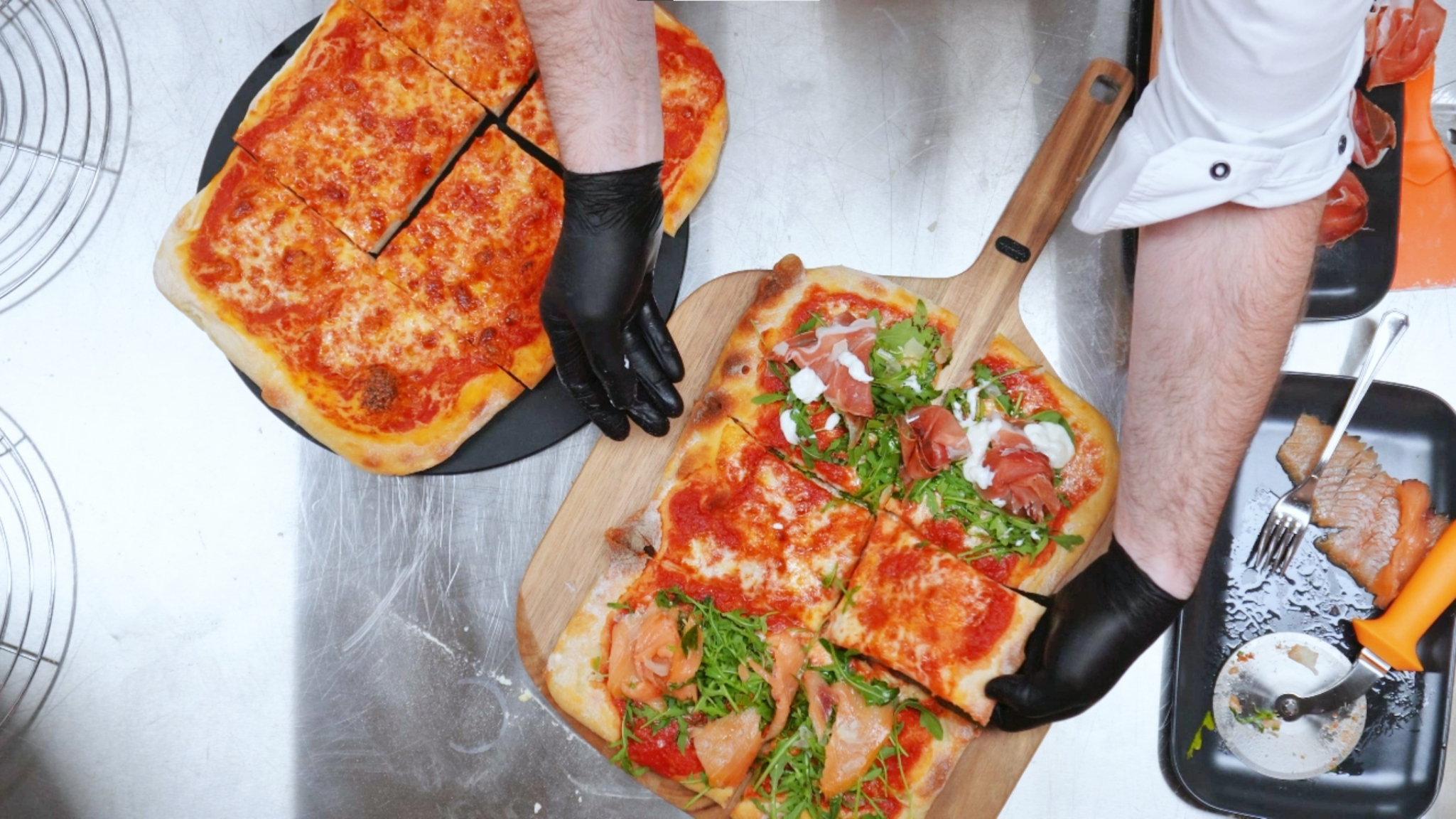
When cutting: Use a Rocker Blade or pizza cutter – a sharp mezzaluna works best for clean cuts. Be really careful, this thing is sharp.
Direct comparison: What’s better?
Honestly: The double-bake method for al taglio wins. In a direct comparison, you can see it immediately – with the directly topped pizza in teglia, the cheese is more browned (slightly burnt) because it’s in for the entire baking time. With al taglio, everything comes together perfectly.
When I make sheet pan pizza at home, I always use the double-bake method. Exception: If I’m short on time or the topping is robust enough (e.g., just tomato sauce without cheese for the first bake).
Products from the video
Caputo Aria
Strong flour (13% protein) with inactive sourdough for more flavor. Perfect for focaccia, in teglia & al taglio.
Sunmix Evo
Spiral kneader for up to 3.5 kg of flour. Ideal for doughs with higher hydration – gentle, even, no over-kneading.
Dough ball containers
For dough portioning. For focaccia, definitely use the tall containers (10 cm) – the dough needs space to rise.
Blue steel pan 40x30x3 cm
Enameled steel pan – ideal for focaccia, teglia, and al taglio. Conducts heat evenly and can easily withstand 250 °C.
Cerutti Aluminum Focaccia Pan 40×30 cm
Professional aluminum pan for perfect teglia pizza and focaccia. Even heat distribution, easy to clean.
Conclusion
One dough, three different results – that’s the beauty of this recipe. You don’t have to make a separate batch for each pizza variation. Prepare the dough balls, let them rest, and spontaneously decide the next day what you want to bake.
The most important takeaways:
- 75% hydration works for all three – ideal if you make them all from one dough
- Yeast directly into the dough, no need to dissolve
- Better to under-knead than over-knead
- Double-baking method for al taglio makes the difference
- For focaccia: more dough (800 g), higher box, more time to rise
If you liked the video – leave a comment, give it a thumbs up, and subscribe to the channel. I’d be happy. See you next time, cheers!
