



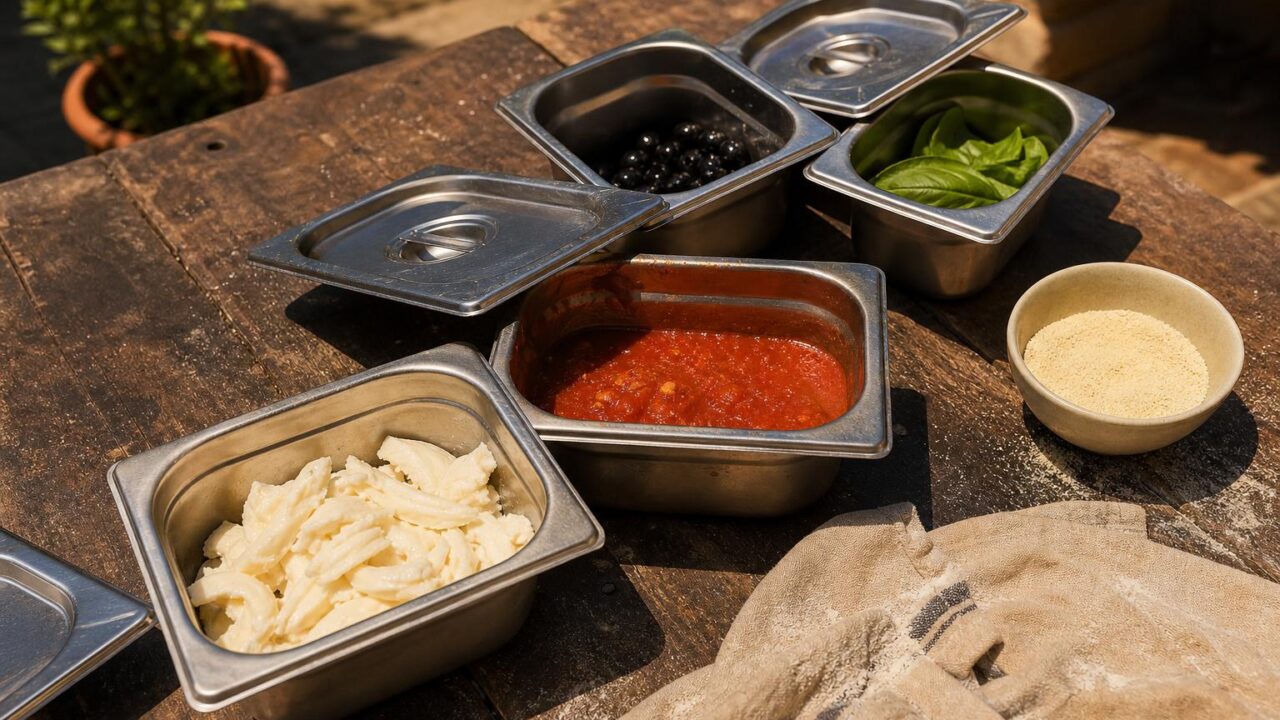
Your buddy is having a garden party. You confidently say: “I’ll make the pizzas, no problem.” Of course. You always do. This will be great.
And then on Saturday afternoon, you’re standing outside, 36°C, the pizza oven is heating up to 450°C, you’re sweating from both sides at once – and the mozzarella starts to melt before it even gets on the pizza.
Welcome to summer pizza reality. The sweat is worth it, I promise. But you have to do a few things differently in this heat than usual.
Why 35°C outside changes everything
In winter, you put your toppings outside and nothing happens. In summer, during a heatwave, ingredients start to change even before you’ve topped the second pizza. Mozzarella gets soft and loses its shape. Fresh herbs wilt in minutes. And then there are the flies.
The second underestimated problem: flies. At 35°C and warm cheese, a fly only needs seconds. And if it lays eggs, you can throw away the whole topping. Sounds dramatic, but it’s completely realistic in this heat. Not pretty, but true.
This is no reason not to have a summer party. But it is a reason to plan differently than in April.
Pizza dough in the heat: what you need to do differently
Let’s start with the dough, because many mistakes happen here that only become apparent when baking. My base for this is always my 8-hour pizza dough – here are the adjustments for summer.
Even less yeast than usual. I generally work with cold fermentation and recommend 1–2g of fresh yeast per kg of flour. In summer, when it gets really warm, I tend to go towards 1g per kg. The warmth massively accelerates fermentation – even in the refrigerator. Too much yeast means an over-fermented dough that tears when you stretch it.
Ice-cold water and lower hydration. Not cold from the tap – really ice-cold water straight from the fridge or cooled down with ice cubes. The dough temperature after kneading should stay below 23–24°C. In summer, I also reduce the hydration: instead of 70–72%, I aim for 65–66%. The dough is softer in the heat anyway and easier to handle with lower hydration.
Use cold fermentation – but shorten the acclimatization. Store the dough in the refrigerator as usual. But on a hot day, 30–60 minutes at room temperature (i.e., outside at 35°C) is perfectly sufficient. The dough warms up much faster than you think.
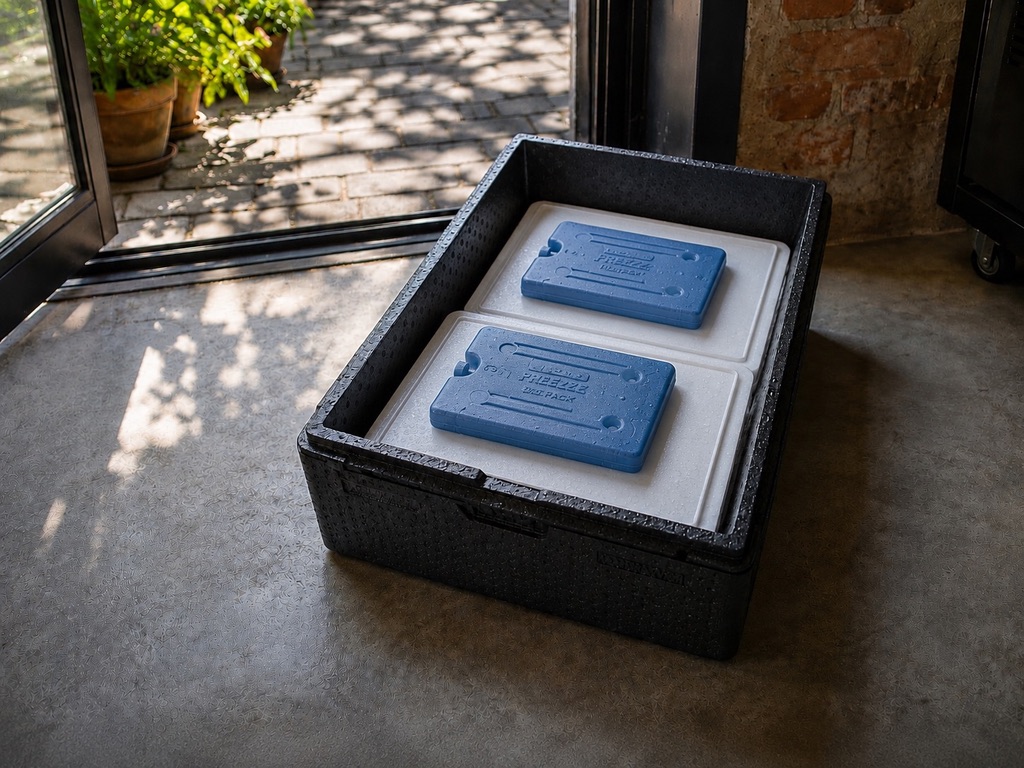
Store dough balls in cool boxes. The dough balls don’t go directly into the box for us – they stay in their dough ball boxes. The dough ball boxes then go into the HENDI Thermobox Profi Line 80L with ice packs. The practical advantage of this box: two dough ball boxes fit side by side. Depending on whether you use 7cm or 10cm high dough ball boxes, you can easily fit 48 dough balls in one thermobox – stacked, with ice packs between the layers. The EPP insulation keeps the temperature stable for hours, even when the sun is beating down on it.
Cooling toppings: the solutions that really work
There isn’t one single solution – but a few approaches that have proven effective in practice:
Small quantities, refill more often
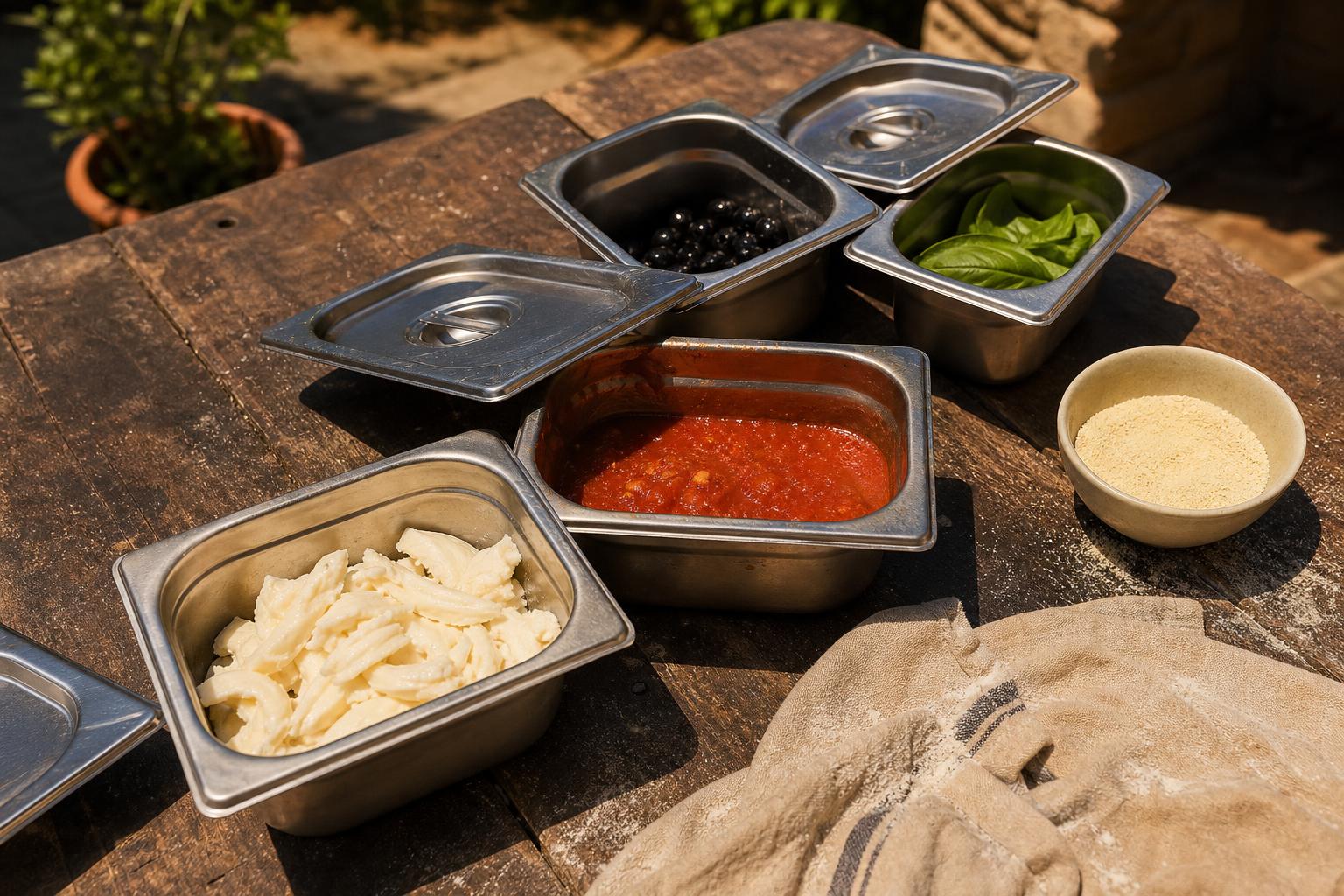
The simplest approach: only take as much out of the fridge as you will use in 15–20 minutes. GN containers with lids, small portions, and briefly go back in to refill. This is annoying during large sessions, but it’s the most reliable method if you don’t have cooling equipment.
Chill GN containers completely beforehand
If you use a topping bar or separate containers: fill the metal containers completely at least an hour before the session and put them in the refrigerator. The mass of the metal plus the cold contents gives you significantly more time outside than if you fill ingredients into warm containers shortly before the party.
Ice water bath or ice packs under the station
Taking it a step further is the ice water bath: you fill the space under the GN containers with ice cubes. Basically a DIY cold bain-marie. Works surprisingly well for a few hours. Similar principle: place a topping bar on ice packs, or put ice packs in a shallow box and place the GN inserts on top.
Even more intense: fill black thermoboxes with crushed ice, then place the GN containers with lids inside. Crushed ice (i.e., crushed ice, available from beverage suppliers) cools more intensely than regular cubes and conforms better to the container shape.
Preparation from the inside – bringing the pizza to the oven
The most pragmatic solution if you have 24°C inside and 35°C outside: simply top it inside, then quickly take it out to the oven. Sounds like extra work, but it’s often less stressful than constantly watching out for things outside. All the stress with heat and flies is eliminated, and the ingredients stay at controlled temperatures. Works particularly well if the pizza oven is fast – with a baking time of 60–90 seconds, the short trip is worth it.
Pizza Saladette: the professional solution
For those who regularly have large summer sessions, an actively cooled saladette is the most sustainable solution. These are preparation tables with integrated GN inserts that are kept at temperature via the refrigerator underneath. Standard in professional kitchens – now also available for ambitious home users, albeit with a corresponding price tag.
We ourselves use an actively cooled top saladette for our summer sessions. This has saved us all the compromise solutions. If this isn’t an immediate budget plan: the ice water bath variant with pre-chilled GN containers is a solid start.
Food safety: what becomes critical at 35°C
A few clear rules for hot days – not to scare you, but because it simply makes sense:
- Mozzarella and fresh cheeses are among the most sensitive toppings. At 30°C+, the cheese begins to melt in chunks and forms an ideal environment for germ growth. Small quantities, covered, always fresh from the fridge.
- Fresh fish and seafood have no place outside at 35°C. Canned tuna is less problematic than fresh salmon – but don’t leave the tuna in the sun for hours either.
- Flies are aggressive at these temperatures. Cover everything that isn’t actively being used. Bowls with lids, inverted plates, cling film. This sounds excessive until it happens to you once. Flies are extremely active in the heat, and open food should never be left unattended.
My setup during the current heatwave
For our own summer sessions, after a few unsatisfactory experiments, we solved it this way: dough ball boxes with ice packs in the HENDI Thermobox – two dough ball boxes fit side by side, stacked we easily fit 48 dough balls in there. Toppings in an actively cooled top saladette. Mozzarella comes out in portions, everything else stays covered until needed.
This has allowed us to bake more relaxed – without constantly being stressed about whether the topping is still okay.
Frequently asked questions: pizza and summer heat
How does pizza dough change at high outdoor temperatures?
Heat significantly accelerates fermentation. At 35°C outdoor temperature, a dough designed for 24 hours at room temperature will be fully fermented in 8–10 hours. The solution: use even less yeast – in summer I go down to 1g fresh yeast per kg of flour for cold fermentation –, use ice-cold water (ice cubes in the water) and slightly reduce hydration (65–66% instead of 70%+). Let the dough mature exclusively in the refrigerator.
How long can pizza toppings sit outside at 35°C?
You can’t give a general answer. It’s best to always keep the toppings covered and only take small amounts out of the cooling that you will use in 15–20 minutes.
What can I do without a saladette to cool toppings?
Three practical options: (1) Fill GN containers with lids, put them in the fridge at least an hour beforehand, then take them out cold. (2) Put ice cubes or crushed ice under the containers – basically a cold water bath. (3) Place ice packs under the topping bar or under the container. All three variants give you a 1–2 hour buffer.
What oil is suitable for pizza dough in summer?
Olive oil as usual. The oil itself is not problematic at summer temperatures. The problem with summer pizza dough is the water temperature and the amount of yeast – address that, not the oil.
Can you still stretch pizza dough outside at 35°C?
Yes, but you have to be quick. Take the dough ball directly out of the cool box, immediately stretch it on semola, top it, and put it in the oven. Don’t let it sit on the work surface in the sun for 10 minutes. With a well-managed dough, you have a short but sufficient window.
Conclusion: Summer pizza is possible – with the right setup
Pizza at 35°C is not rocket science, but it requires a few adjustments. Less yeast, colder water, hydration down to 65–66%, dough ball boxes in the thermobox, toppings consistently cooled and covered. Once you have this set up, you can bake relaxed even in a heatwave.
How does it work for you in the summer? Write it in the comments – I’m interested in what works for you.
