



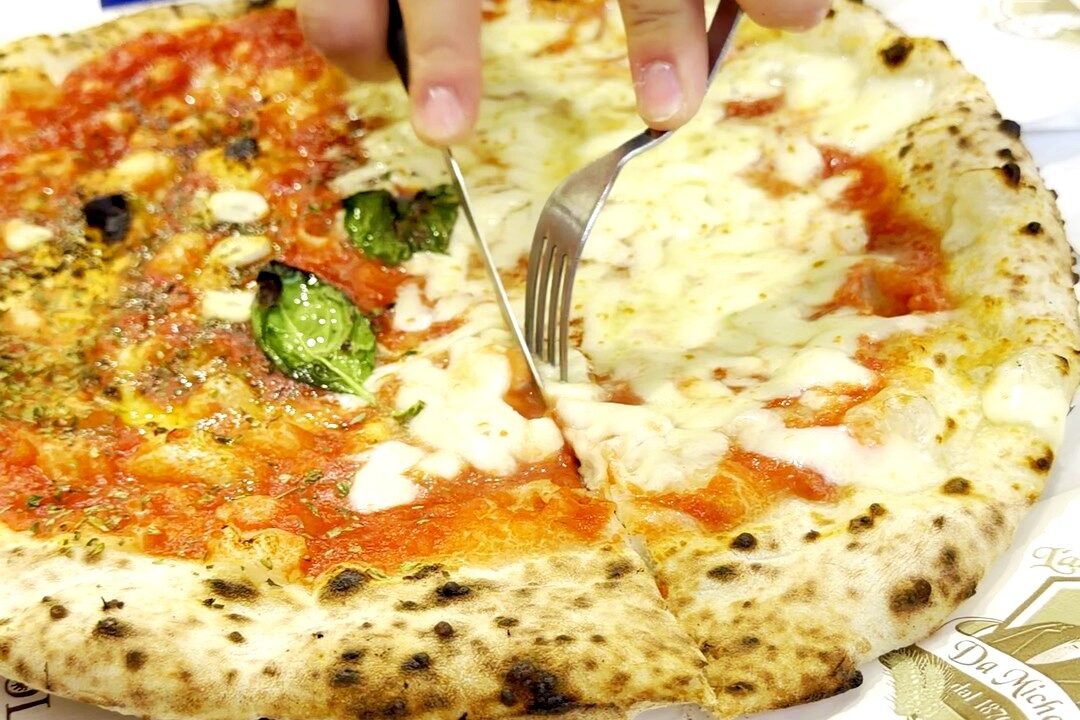
A huge pizza hangs limply over the edge of the plate. A slice is folded and eaten by hand. New York style, right?
No. That could be Ruota di Carro, a centuries-old Neapolitan tradition with a completely different dough and baking profile.
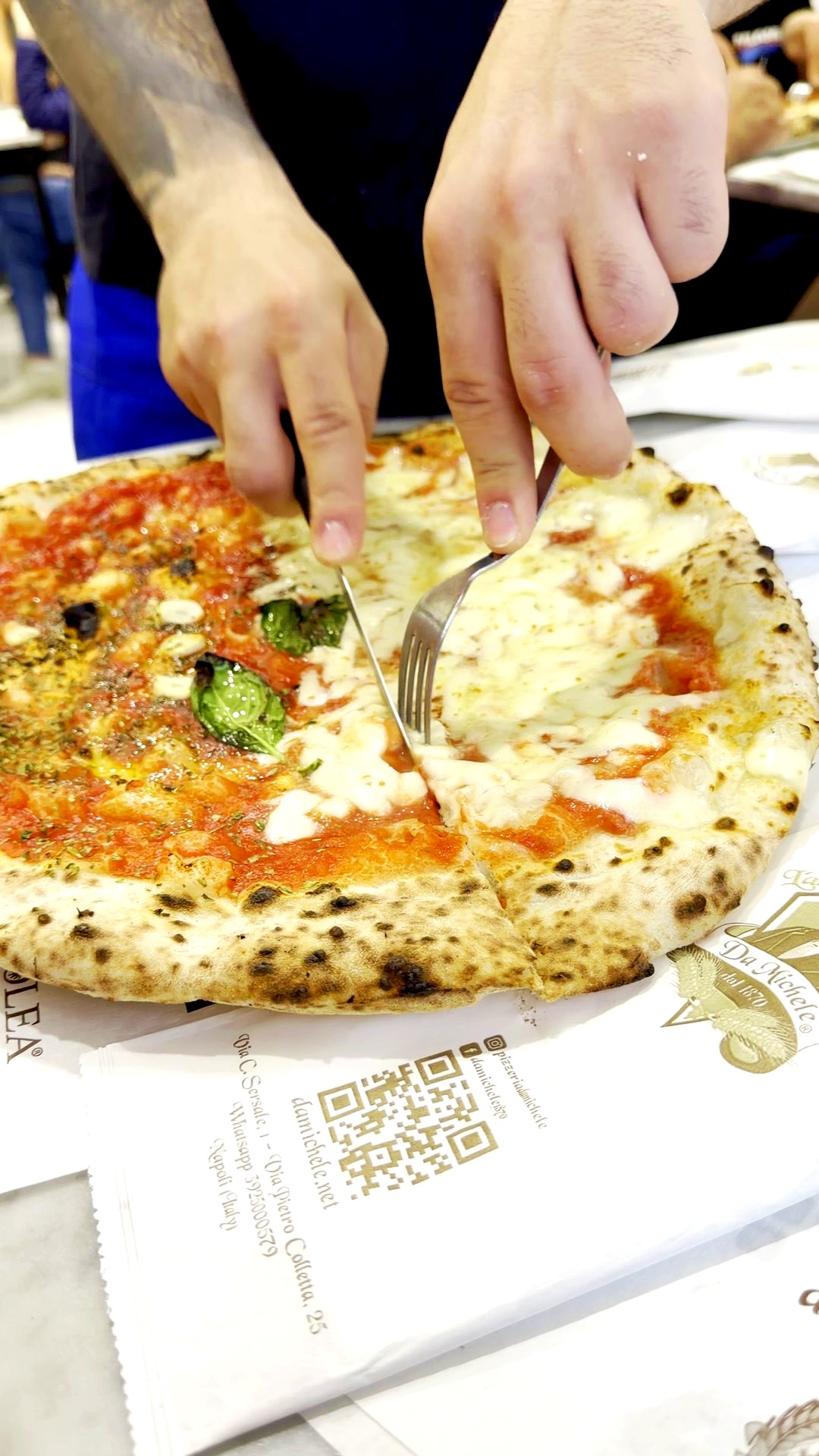
Ruota di Carro and Roman Pizza: where the difference really lies
The confusion arises from two superficial similarities: Both pizzas can be large and are made very thin. But that’s practically where the kinship ends.
Ruota di Carro belongs to Neapolitan pizza. It remains soft, elastic, and foldable. That’s precisely the intention.
The classic Roman pizza, more precisely Pizza tonda romana, pursues the opposite goal. It should be flat, dry, rigid, and distinctly crispy.
New York style is also something distinct. Its large, thin, and pliable slices are typically folded by hand. Visually, this assumption is closer to a floppy pizza than “Roman.” Nevertheless, Ruota di Carro is neither New York nor Rome, but Naples.
What is Ruota di Carro anyway?
Ruota di Carro literally means “wagon wheel.” “Ruota” means wheel, “carro” means wagon or cart.
The name fits. Such a pizza can reach 30 to over 40 centimeters in diameter. The center is paper-thin, the edge is low, and the pizza often extends beyond the plate.
Nevertheless, Ruota di Carro is not a separate pizza genre. It is a traditional expression of Pizza Napoletana, i.e., Neapolitan pizza.
The first known mention dates back to around 1500. The Neapolitan poet and singer Velardiniello referred to the pizza in his verses as “rota ’e carretto” because of its size, meaning wagon wheel in the Neapolitan dialect.
The style originated from cucina povera, the simple cuisine of the poor in the working-class neighborhoods of Naples. Pizza makers stretched the same amount of dough particularly wide and thin. This resulted in more slices, and more people were fed.
Closely associated with this style is L’Antica Pizzeria Da Michele. The Condurro family has shaped Ruota di Carro for five generations in the Neapolitan districts of Tribunali and Forcella.
Source: Eataly Magazine, “What is Pizza A Ruota di Carro?”, Luciano Pignataro Wine&Food Blog
Typical characteristics include:
- approximately 30 to over 40 centimeters in diameter
- a low rim of about 1 centimeter
- a very thin center
- soft, elastic, and foldable dough
- deliberately simple toppings like tomatoes, mozzarella, and fresh basil
- a short baking time at very high temperature
The dough is traditionally prepared directly with yeast. “Direct” means that no separate pre-dough is used. It ferments at room temperature for about 24 hours and is then formed into dough balls. Fermentation is simply the maturation of the dough through yeast and time.
The hydration, i.e., the ratio of water to flour, for AVPN standard Neapolitan pizza is between 55 and 62 percent. AVPN stands for Associazione Verace Pizza Napoletana, the association for traditional Neapolitan pizza.
When spreading, the dough is stretched by hand. Use semola or regular flour for this. Tipo 00 belongs in the dough, but it’s not my choice for spreading itself.
Is Ruota di Carro simply Roman pizza?
No.
Ruota di Carro should remain soft and elastic despite its thin center. In contrast, Pizza tonda romana should become dry, brittle, and crispy.
These are not minor regional variations. Both styles are based on a different desired outcome. Therefore, the dough recipe, preparation, temperature, and baking time differ.
If you bite into a Ruota di Carro and don’t hear a distinct crunch, it’s not a mistake. If a Pizza tonda romana can be folded softly, then its actual goal has been missed.
What is actually meant by “Roman pizza”?
In this comparison, I mean Pizza tonda romana. This is a round, very thin Roman pizza with a dry, crispy crust.
The dough is often rolled out with a rolling pin. This creates a uniformly flat disc, without the typical Neapolitan rim.
However, Roman pizza can also mean Pizza al taglio or Pizza in teglia. These are usually rectangular versions baked in a pan and cut into slices. Pinsa is also often thrown into the same category, but it’s not meant here.
The most important differences at a glance
| Characteristic | Ruota di Carro | Pizza tonda romana | New York Style |
|---|---|---|---|
| Origin | Naples | Rome | New York, USA |
| Pizza family | traditional expression of Pizza Napoletana | independent Roman style | own US style, derived from Neapolitan immigrants |
| Goal | soft, elastic, and foldable | dry, brittle, and crispy | crispy on the outside, soft and foldable on the inside |
| Oil in dough | traditionally no olive oil | deliberately olive oil in the dough | oil and usually some sugar in the dough |
| Preparation | stretched wide and thin by hand | often rolled out with a rolling pin | stretched and thrown by hand |
| Rim | low, about 1 centimeter | very flat, barely pronounced | medium, not emphasized |
| Dough handling | direct yeast dough, about 24 hours at room temperature | often double fermentation, e.g., 60 minutes bulk fermentation, 12 hours cold and 4 hours acclimatization | usually 24 hours or longer in the refrigerator |
| Baking temperature | over 400 °C | approximately 250–300 °C | approximately 290–320 °C |
| Baking time | about 60–90 seconds | several minutes | about 6–10 minutes |
| Bite | soft and pliable | rigid and crunchy | crispy crust, soft foldable center |
Why thin doesn’t automatically mean crispy
Now we come to a real frustration when baking yourself.
You stretch your dough particularly thin. You expect a crispy crust like a Roman pizza. After baking, the pizza is thin, but soft and pliable.
This is logical if you use a Neapolitan dough with a Neapolitan baking profile. The thickness alone doesn’t determine the crunch.
In Pizza tonda romana, there is deliberately olive oil in the dough. The oil gets between the gluten strands and slightly weakens the gluten network (the protein structure in the dough that gives it elasticity and cohesion). This makes the baked crust less elastic and more brittle.
The type of flour must also match the desired dough, the amount of water, and the long fermentation. A flour is not automatically better just because “Pizza” or “Tipo 00” is on the package. What matters is whether the recipe and maturation time fit together.
The second major lever is the baking profile. Neapolitan dough is baked at over 400 °C for only 60 to 90 seconds. In this short time, more moisture remains in the dough. This results in the soft, elastic character.
Pizza tonda romana is baked at approximately 250 to 300 °C for several minutes. The crust loses more moisture during this time and dries out more. This creates the desired crunch.
Thin does not equal crispy.
For a Roman-crispy crust, you need the right dough recipe with oil, a suitable flour, and a longer baking profile at moderate temperature. Just stretching it thin is not enough.
This is precisely why you can make two pizzas almost the same thickness and still get completely different results. One can be folded, the other breaks.
🔥 What oven do you need for which style?
For Ruota di Carro, you need very high heat. A true Neapolitan baking process works at over 400 °C, practically 450 °C or more.
Special pizza ovens like models from Gozney, Effeuno, or Witt can achieve this. At this heat, the pizza is ready after 60 to 90 seconds. You have to watch it during baking and usually turn it.
A normal household oven usually doesn’t reach this temperature range. You can bake a thin pizza in it, but the result won’t have exactly the same soft Neapolitan character.
Pizza tonda romana is much more forgiving for the household oven. It requires a lower temperature and several minutes of baking time anyway. A well-preheated baking steel or pizza stone can help, but it’s not a substitute for the right recipe and handling.
And what about Canotto or Pizza Contemporanea?
Canotto refers to a modern Neapolitan pizza with a very large, airy crust. The name is reminiscent of an inflatable swimming ring.
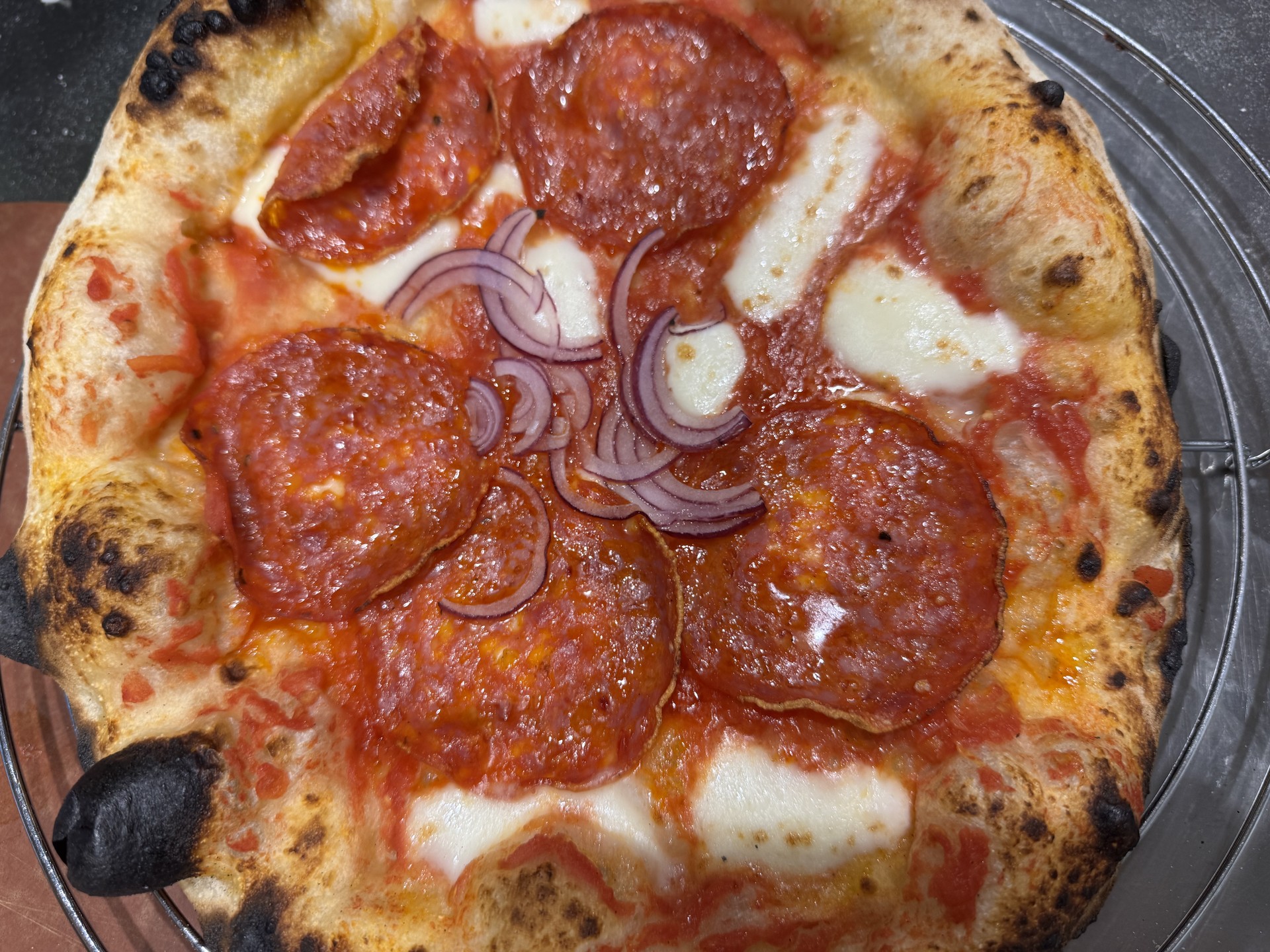
Pizza Contemporanea means modern or contemporary pizza. It often involves higher hydration, longer dough fermentation, and a noticeably airy Cornicione. The Cornicione is the outer rim of the pizza.
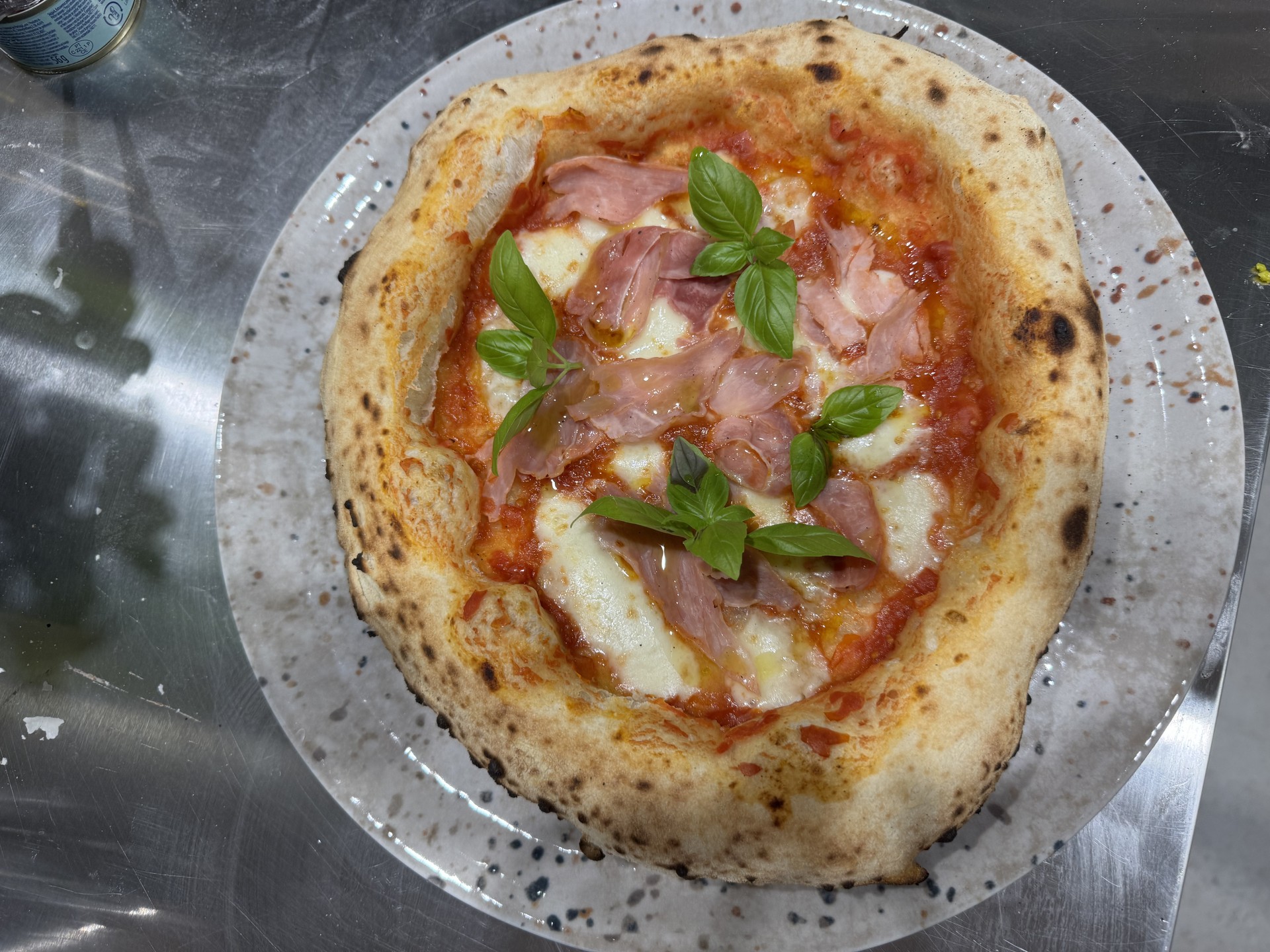
Ruota di Carro seems almost like the antithesis to that. The dough is deliberately spread out widely. The crust remains low, about 1 centimeter, with the large surface area being the focus.
That doesn’t mean one style is better than the other. They are different ideas of what a Neapolitan pizza should look and feel like when eaten.
Which style suits you?
If you want a soft pizza that you can fold, Ruota di Carro is a good fit for you. However, you need a very hot oven and some skill in spreading it out widely.
If you’re looking for an audible crunch and a drier base, Pizza tonda romana is the better direction. It can also be successfully made in a normal home oven.
If you like a high, airy crust, Canotto or Pizza Contemporanea are closer to your ideal. If you find a large crust gets in the way, the flat Ruota di Carro can be particularly interesting.
The important thing is that you know what result you actually want before baking. Otherwise, you’ll use a Neapolitan dough, bake it in the Roman style, and wonder why the base is neither soft nor truly crispy.
Why the wagon wheel won’t let me go
What fascinates me about Ruota di Carro isn’t just the size. It’s the simplicity behind it. Little dough, simple toppings, and a technique that has worked for centuries.
The style also shows that a massive crust isn’t automatically the mark of quality for a good pizza. A thin, soft pizza can have just as much character.
Which pizza do you prefer, soft and foldable from Naples or dry and crispy from Rome? Write it in the Facebook group PizzaLiebhaber Österreich. I’m particularly interested in what works better in your own oven.
Three more questions I often get asked about this
Is that actually New York Style?
Not quite. While New York Style also has a soft, foldable base, the dough usually contains oil and some sugar for browning, and it’s baked at around 290 to 320 °C for several minutes instead of over 400 °C in seconds. Ruota di Carro sticks to the pure Neapolitan recipe without oil in the dough.
How thick is the crust on Ruota di Carro really?
About 1 centimeter. With Canotto or modern Neapolitan pizza, the crust often puffs up to 3 to 4 centimeters, which is a noticeable difference when you bite into it.
Is Roman pizza always pizza al taglio?
No, and this is constantly confused. Pizza al taglio or Pizza in teglia is the rectangular pan pizza sold by the slice. The round, crispy pizza in this comparison is called Pizza tonda romana and is a separate style.
