



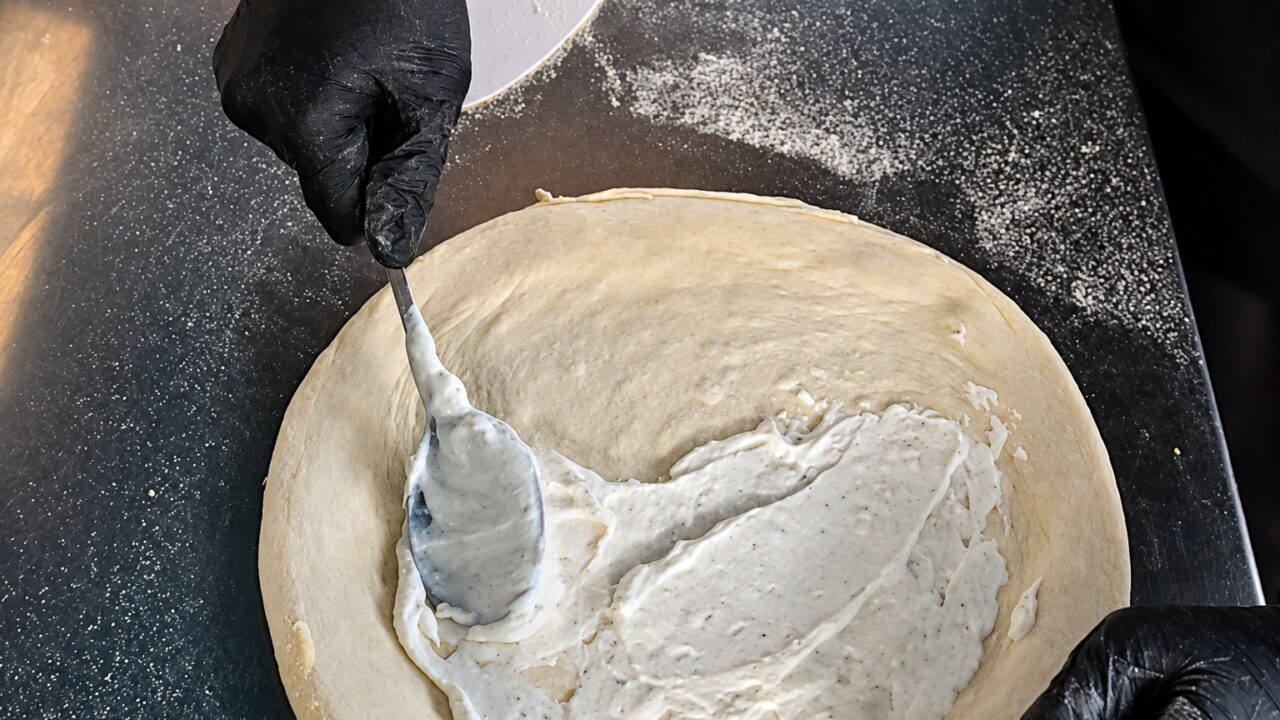
The 3-tip squeeze bottle draws fine white lines over the finished pizza after baking. Cold meets warm, creamy meets crispy. This ricotta sauce is made for exactly that, and it has two separate applications: as a base before baking, which is easily spread with a spoon, and as a finishing touch afterwards from the bottle.
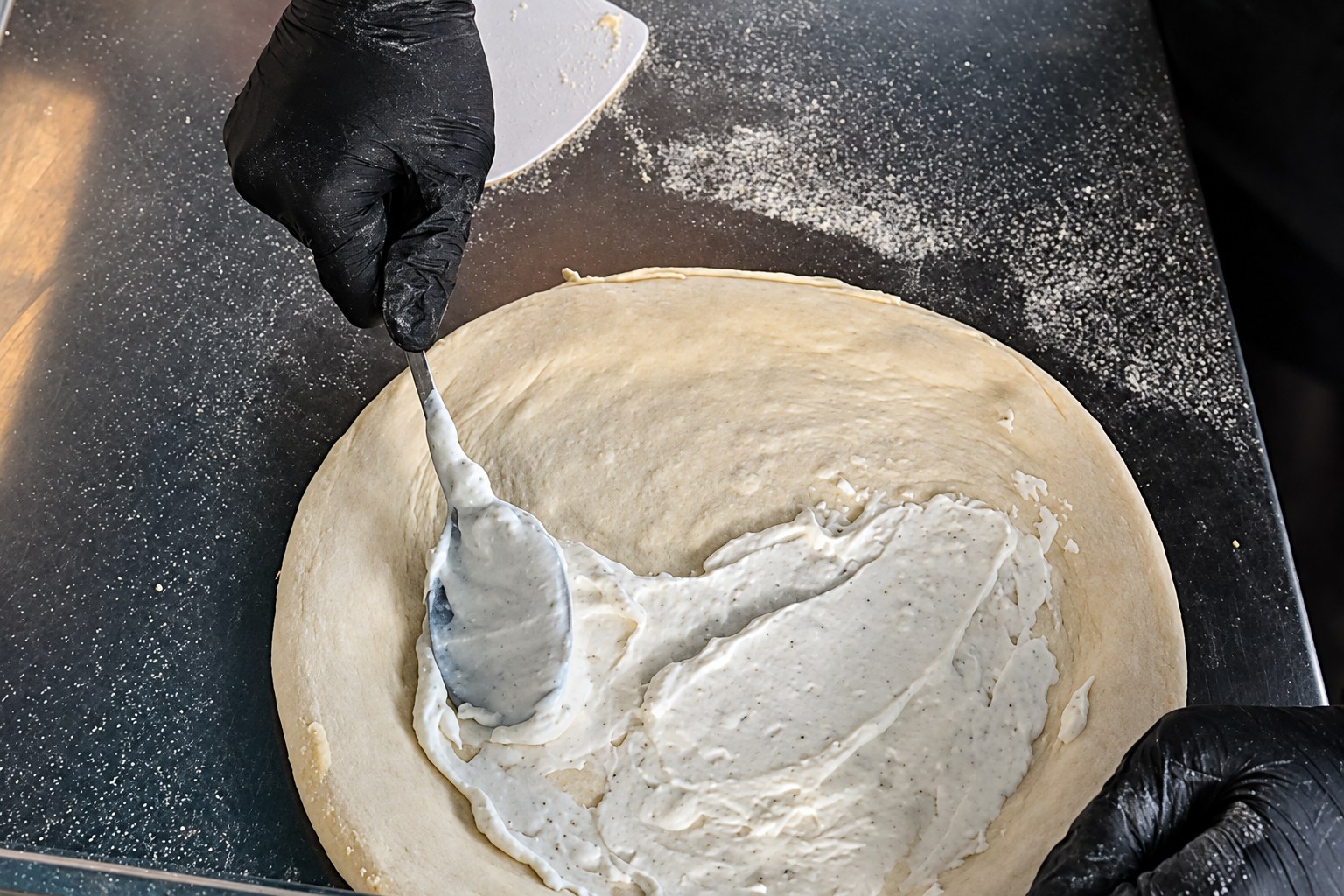
What is a ricotta sauce for pizza? 🧀
If you’re looking for a pizza bianca sauce recipe that you can actually drizzle from a bottle, you’ve come to the right place. Most recipes you’ll find mean thick dollops of ricotta, creamy and pure. This sauce here is intentionally thinner, almost like liquid Greek yogurt. Ricotta, water, olive oil, and salt are mixed until there are no lumps left. Finally, a splash of lemon and pepper are added.
There’s another white sauce on pizza, Parmesan cream. It tastes completely different: rich, salty, nutty, almost like pure melted cheese. This ricotta sauce here is the opposite, mild and slightly sweet-milky. It doesn’t push itself to the foreground, but leaves room for the toppings.
The basic recipe with ricotta 🥣
- 🧀 Ricotta – 250 g
- 💧 Cold water – 80 to 100 g
- 🫒 High-quality olive oil – 25 g
- 🧂 Salt – 4 g, plus to taste for seasoning
- 🍋 Lemon juice – a splash, for seasoning
- 🌶️ Black pepper, freshly ground – to taste
- Optional: 🧀 Finely grated Parmesan – 10 to 15 g
Mix ricotta, water, olive oil, salt, and, if desired, Parmesan with an immersion blender or Thermomix until a completely smooth cream is formed. For me, this takes less than two minutes.
🍋 Don’t forget to season
I like to season the sauce at the end with a splash of lemon juice, freshly ground pepper, and a pinch of salt if needed. The lemon adds freshness, the pepper a bit of spice. It’s better to season in small steps and taste as you go.
The right consistency 💧
💧 Consistency check
For finishing, the sauce should run through the 3-tip squeeze bottle like liquid Greek yogurt. For the base with the spoon, it can be a bit thicker.
- Runs cleanly from all tips
- Does not drip
- Contains no lumps
- Forms even lines
Too thick? Add water tablespoon by tablespoon until it’s right.
One sauce, two applications 🔥
The sauce works in two ways. The difference lies solely in the timing.
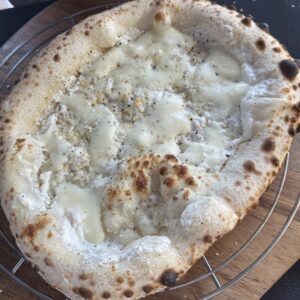
As a base: spread 50 to 70 g thinly on the dough with a spoon before adding the toppings. You don’t need the bottle for this. It replaces the tomato sauce and gives you a creamy, mild base. If you prefer to stick with classic tomato sauce, you can find my original recipe here. Another cream base is my zucchini cream.
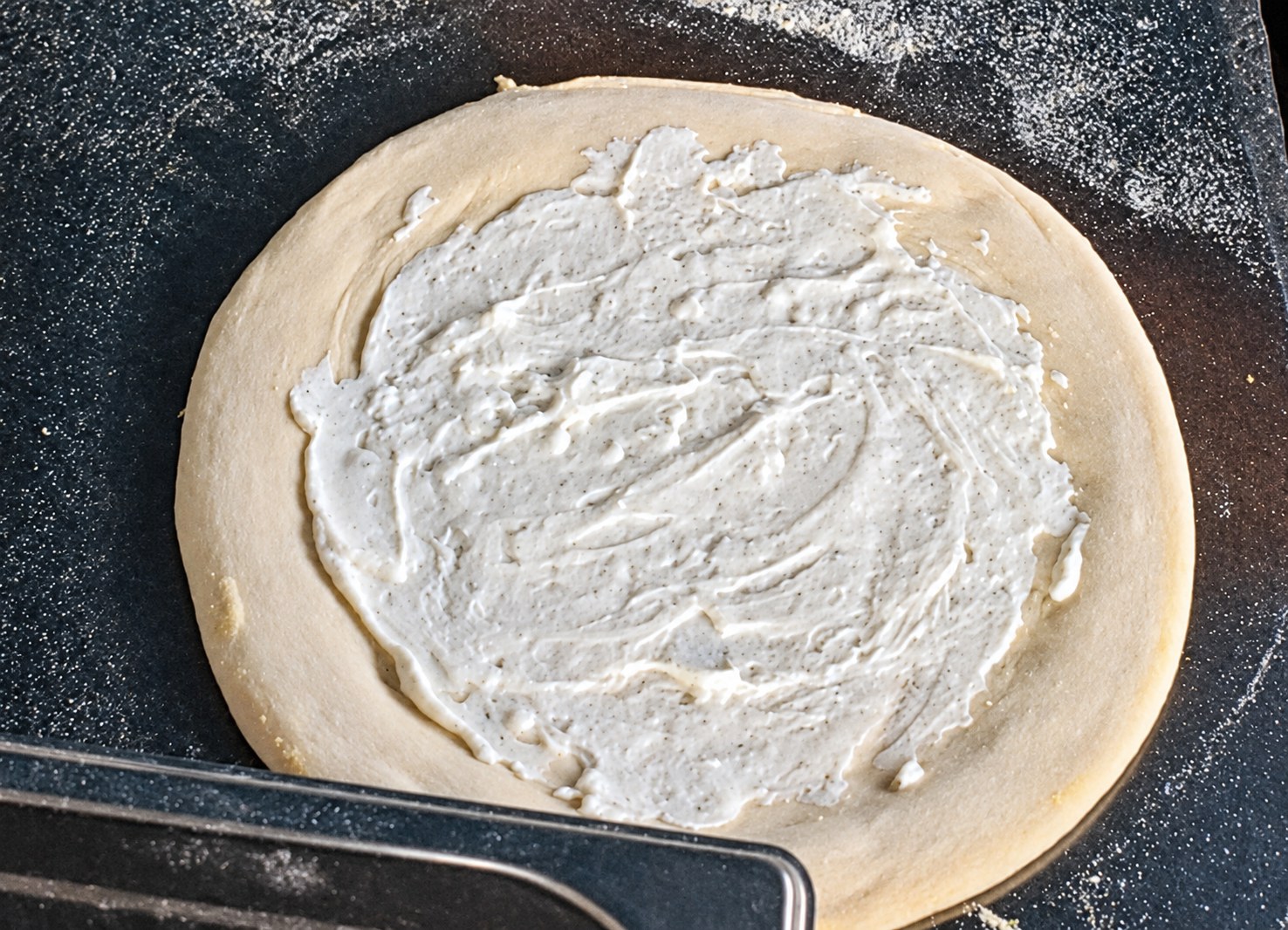
As finishing: after baking, drizzle the same sauce, slightly thinned with water if necessary, in fine lines over the finished pizza using the squeeze bottle. The contrast between the warm base and the fresh, cool cream is what I love most about this technique.
🔥 Practical tip
Prepare a slightly thicker basic sauce, use it directly as a base, and thin a portion with a little water for finishing. This way, you have one sauce for both applications.
Why olive oil makes the difference 🫒
25 g of olive oil make the sauce smoother, shinier, and more aromatic. If you see visible oil streaks in white sauces at pizzerias, the oil was often stirred in just before serving or not fully emulsified. This is not a mistake, just a different way of building the sauce. When mixing, the oil combines into a homogeneous cream.
No ricotta? Quark alternatives 🥛
Quark is firmer and more acidic than ricotta, so it needs more water. Both versions work with the squeeze bottle.
- 🥛 Quark (20 to 40% fat) – 250 g
- 💧 Water – 100 to 130 g
- 🫒 Olive oil – 25 to 30 g
- 🧂 Salt – 4 g
This version is closer to Austrian cuisine because quark is simply in everyone’s fridge here.
- 🥛 Quark – 200 g
- 🧀 Mascarpone – 50 g
- 💧 Water – 100 to 120 g
- 🫒 Olive oil – 25 g
- 🧂 Salt – 4 g
Mascarpone makes the sauce milder and creamier, closer in taste to classic ricotta sauce. So if you’re looking for a pizza bianca with mascarpone, this is the version.
I also season the quark versions at the end with lemon, pepper, and salt. Be careful with the lemon, though, as quark itself already has acidity.
What toppings go well with it? 🍄
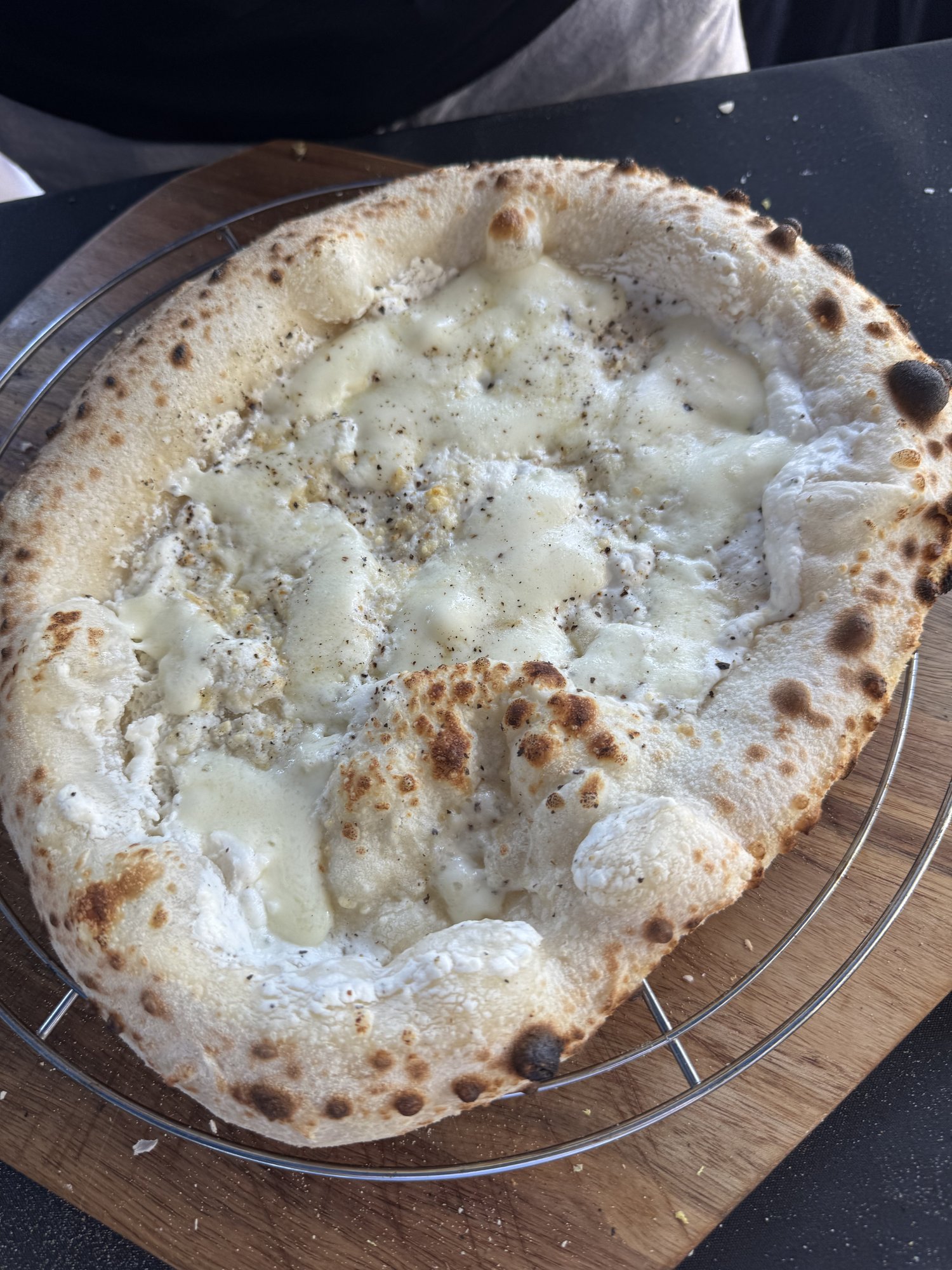
- Mortadella & Pistachios
- Potatoes & Rosemary
- Pancetta
- Nduja
- Burrata
- Grilled Zucchini
- Mushrooms
- Roasted Eggplant
- Truffle
- Honey and spicy salami with Hot Honey Topping
Truffle and this mild ricotta sauce work particularly well together because the sauce leaves room for the truffle.
I like ricotta sauce because it doesn’t make a white pizza heavy. It’s my standard when I show guests that pizza doesn’t always have to be red. What topping combination would you try with the white sauce? Write it in the Facebook group PizzaLiebhaber Österreich, I’m curious.
If you’re ordering anyway: The 3-tip dispenser bottle is available in my shop, it’s the tool for this technique.
Ricotta-Sauce für Pizza (Base & Finishing)
Ingredients
Grundrezept (Ricotta)
- 250 g Ricotta
- 90 g Wasser, kalt 80-100 g, je nach Konsistenz
- 25 g Olivenöl hochwertig
- 4 g Salz plus nach Geschmack zum Abschmecken
- 1 Spritzer Zitronensaft zum Abschmecken
- 12 g Parmesan, fein gerieben optional
- Schwarzer Pfeffer, frisch gemahlen nach Geschmack
Alternative: Topfen statt Ricotta
- 250 g Topfen 20-40% Fett
- 115 g Wasser, kalt 100-130 g
- 27 g Olivenöl 25-30 g
- 4 g Salz
Alternative: Topfen + Mascarpone (näher am Original)
- 200 g Topfen
- 50 g Mascarpone
- 110 g Wasser, kalt 100-120 g
- 25 g Olivenöl
- 4 g Salz
Instructions
- Alle Zutaten einer Variante außer Zitronensaft und Pfeffer in ein hohes Gefäß geben.
- Mit Stabmixer oder Thermomix mixen, bis eine vollkommen glatte Creme entsteht.
- Mit einem Spritzer Zitronensaft, frisch gemahlenem Pfeffer und bei Bedarf noch etwas Salz abschmecken. Bei den Topfen-Varianten mit der Zitrone sparsamer sein.
- Konsistenz prüfen: Fürs Finishing sollte die Sauce wie flüssiger griechischer Joghurt aus einer 3-Spitzen-Squeeze-Flasche laufen, ohne zu tropfen. Für die Base darf sie etwas dicker sein.
- Zu dick? Esslöffelweise kaltes Wasser ergänzen und nochmal kurz mixen.
- Als Base: 50-70 g mit dem Löffel dünn auf dem Teig verteilen, bevor der Belag kommt.
- Als Finishing: Nach dem Backen in feinen Linien über die heiße Pizza auftragen, bei Bedarf nochmal leicht mit Wasser verdünnen.
