


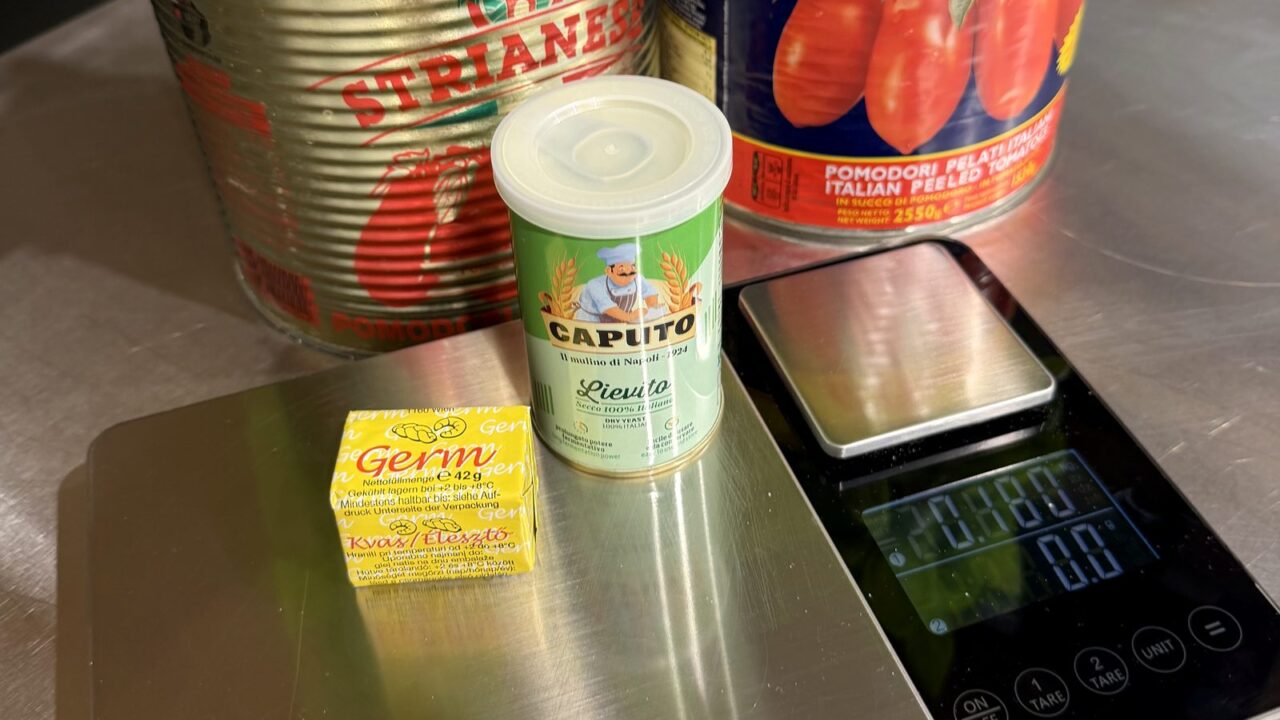
A cube of yeast weighs 42 g, but for my pizza dough I only need 1.5 to 2 g of it per kilo of flour. No wonder many people prefer to use dry yeast or wonder if the yeast flakes from the box are enough.
I’ll go through everything on the shelf that sounds like yeast: what really makes your dough rise, how to convert between fresh and dry, and what just sounds like it.
🍞 Fresh yeast or dry yeast: the short answer
Both make your pizza dough rise. You just need different amounts of each and handle them a little differently.
It only gets tricky with products that just sound similar. Yeast flakes are for seasoning, inactive yeast makes the dough more elastic, and supermarket sourdough powder adds acidity and flavor. None of these can replace your yeast.
Fresh yeast (cube)
Makes it rise: yes
Add directly to the dough or dissolve in water beforehand
Active dry yeast
Makes it rise: yes
Dissolve in warm water beforehand
Instant yeast
Makes it rise: yes
Mix dry with other ingredients
Inactive yeast
Makes it rise: no
Makes the dough more elastic
Yeast flakes
Makes it rise: no
For seasoning
Sourdough powder (supermarket)
Makes it rise: usually no
Adds acidity and flavor, yeast needs to be added separately
Brewer’s yeast as a dietary supplement
Makes it rise: not intended for baking
Read the package
The distinction between active dry yeast and instant yeast comes from the Technical Information Booklet of US mill Pendleton Flour Mills. However, don’t rely too much on the names, manufacturers don’t use them consistently. What this means in practice, you’ll see on the Caputo can below.
💡Converting fresh yeast to dry yeast
- Instant yeast: fresh amount × 0.33 to 0.36, so around one-third
- Active dry yeast: fresh amount × 0.4 to 0.45
For my basic recipe with 2 g fresh yeast per 1 kg flour, this means: around 0.7 g instant yeast or 0.8 to 0.9 g active dry yeast. If the package has its own conversion, use that.
🇦🇹 Germ or Hefe? Same thing, two words
Whether a recipe says ‘Germ’ or ‘Hefe’ doesn’t matter, it’s the same ingredient. According to the Digital Dictionary of the German Language (DWDS), ‘Germ’ is used in Austria and Bavaria, while in the rest of the German-speaking world it’s called ‘Hefe’.
It’s nice to know where the two words come from. ‘Germ’ comes from the Middle High German ‘gerwe’ and is related to ‘gären’ (to ferment), while ‘Hefe’ comes from ‘heben’ (to lift). So, we Austrians name it after fermentation, and Germans after lifting.
Italian recipes can be a trap. They say ‘lievito di birra’, literally brewer’s yeast, and you’ll find yourself in the drugstore looking at tablets. But they mean regular fresh yeast, the cube. Biologically, it’s the same species as ours: Saccharomyces cerevisiae.
By the way, our ‘Germ’ has nothing to do with the Italian ‘germe’, which means germ or sprout. What ‘con germe’ means on a flour bag is explained in the article about Con Germe Flour.
⬆️ The three that make your dough rise
The quantities and handling in this section also come from the Pendleton booklet. They are good for orientation, but what’s on your own product’s packaging still applies.
Fresh yeast: the cube
Fresh yeast consists of about 70% water and therefore always needs to be kept in the refrigerator, otherwise its leavening power decreases. You can crumble it directly into the dough or dissolve it in water beforehand.
For my dough with cold fermentation, meaning when it rises in the refrigerator, I use 1.5 to 2 g of fresh yeast per 1 kg of flour. I always weigh it, because with such small amounts, an estimated piece of the cube is far too inaccurate. For this, you need a scale that weighs accurately to 0.1 g.
Freezing fresh yeast
With these amounts, almost all of the cube remains. I freeze the rest in small balls, slightly larger than my usual amount: if I normally use 2 g, I make the balls 2.5 to 3 g heavy. The frozen ball then goes directly into the dough, without thawing.
There’s a reason for the extra amount. When freezing, some of the yeast dies, and the longer it stays in the freezer, the more dies. A study by Ribotta, León, and Añón from 2003 showed this: yeast stored at -18 °C produced less gas, and the proportion of dead cells increased. The dead cells also make the dough slightly softer, the reason for which you’ll read about later under inactive yeast.
Therefore, I only freeze as much as I will use in the foreseeable future. Once thawed, it doesn’t go back into the freezer.
Active dry yeast: dissolve beforehand
According to the booklet, active dry yeast contains only 7.5 to 9% water and therefore lasts much longer. You dissolve it in water at 32 to 38 °C before processing and let it sit for 5 to 10 minutes.
You need 0.4 to 0.45 times the amount of fresh yeast, so 2 g of fresh yeast becomes 0.8 to 0.9 g. The well-known one-third rule doesn’t apply here; that’s for instant yeast.
If your dough doesn’t rise as expected with dry yeast, first check which product you have and which conversion you used.
I myself only use dry yeast when I don’t have fresh yeast on hand. There’s no particular reason for it.
Instant yeast: mix dry first
Instant yeast, often also called instant-Hefe, comes vacuum-packed. Here, about one-third of the fresh amount is sufficient, specifically 0.33 to 0.36 times.
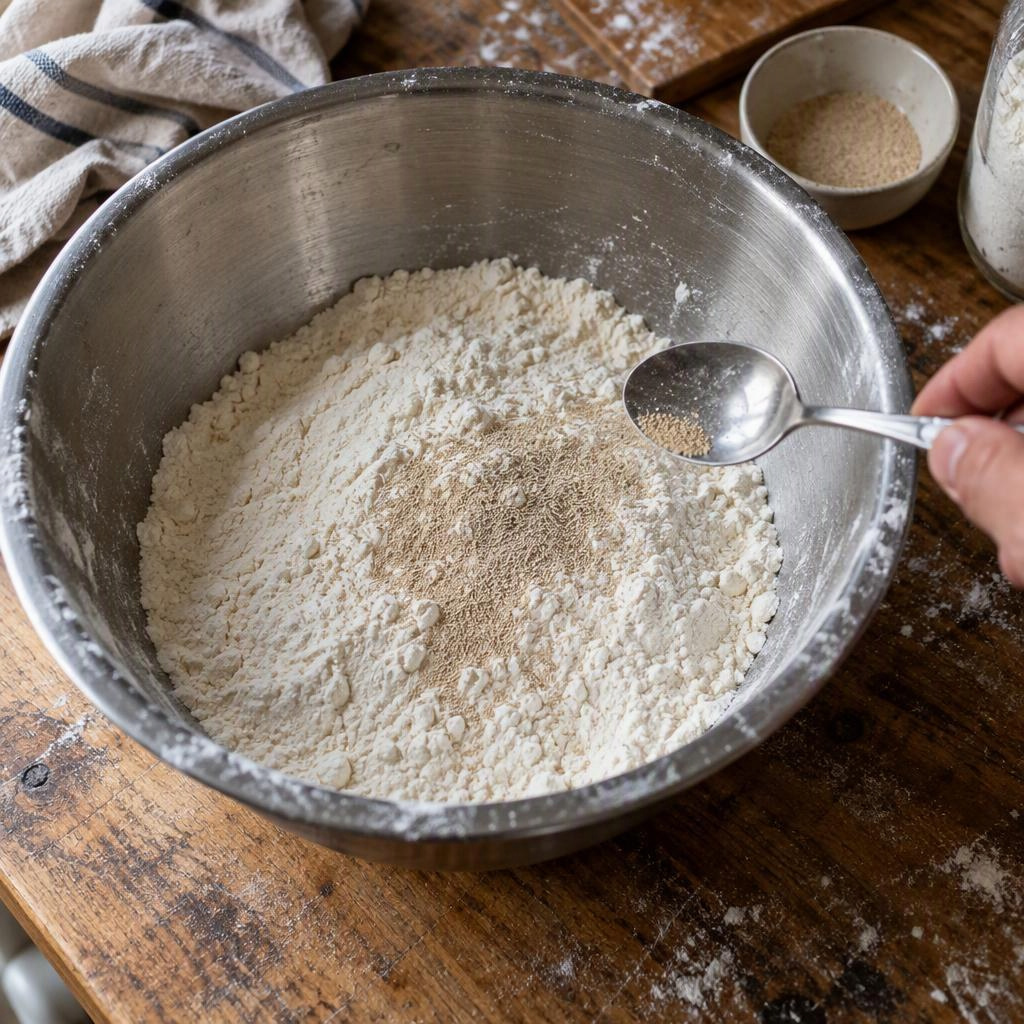
According to the booklet, it cannot tolerate cold water directly poured on it. Therefore, mix it dry with the other ingredients for 1 to 2 minutes first, and only then add the water.
⚠️Salt and yeast
Don’t let salt and yeast sit together in water before the flour is added. Otherwise, the leavening power will decrease.
🥫 Pizza dough with dry yeast: what the can says counts
How little the names mean is clearly shown by the Caputo Lievito Secco, the dry yeast I have in the shop. The can says ‘High Activity Dry Yeast’, and on its website, Caputo calls it ‘active dry yeast’.
According to the classification above, you would dissolve it in warm water. However, the can says something different: mix it with the flour before adding the other ingredients, dissolving is not necessary. And according to Caputo, one-third of the fresh amount is sufficient.
Mixing dry and using one-third are exactly the characteristics of instant yeast, even if it says ‘active’ on it.
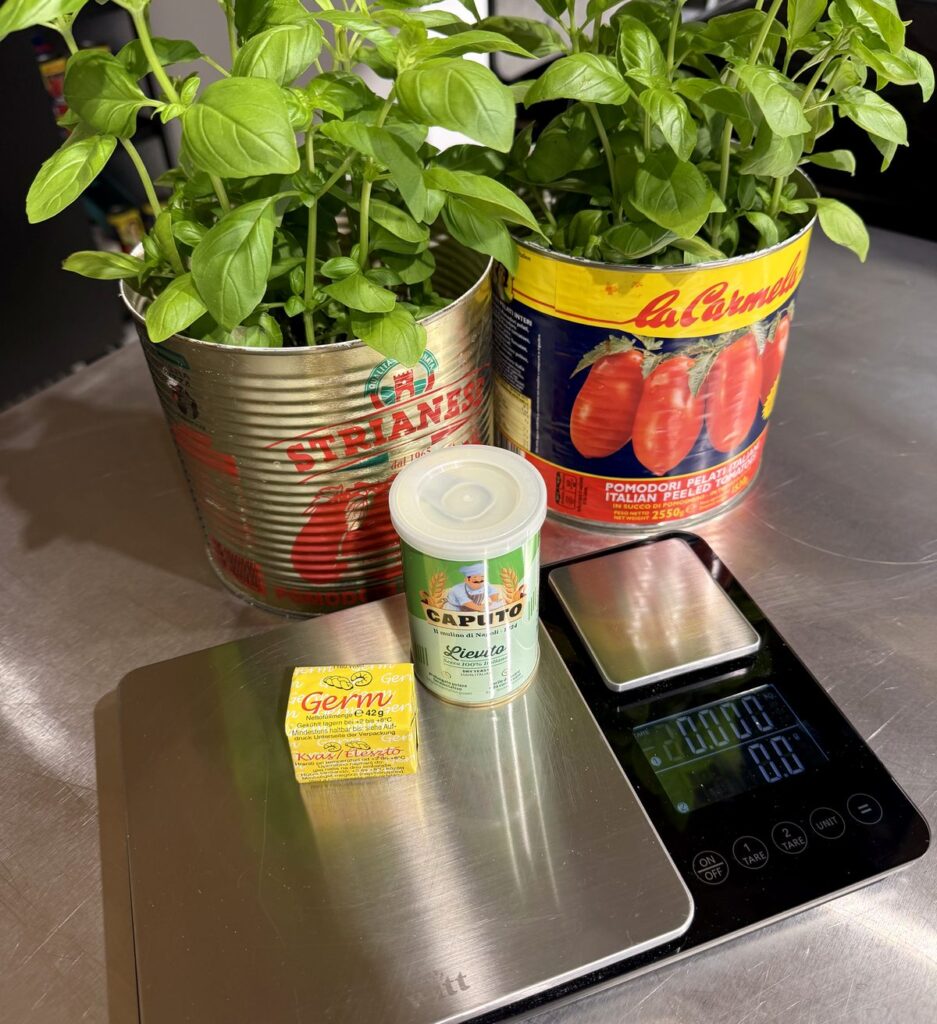
For 500 g of flour, the can provides these amounts:
- 4 hours proofing: 3 teaspoons
- 8 hours proofing: 2 teaspoons
- 12 hours proofing: 1 teaspoon
There are no grams listed, so I’m not converting the teaspoons here. The amounts correspond to the specified proofing times and are not a flat rate for every pizza dough.
Inside are baking yeast and the emulsifier sorbitan monostearate. Once the can is open, put the lid back on and store it in the refrigerator at 0 to 10 °C. According to the packaging, you should use it within 2 months.
⚠️Don’t go by the name
‘Active dry yeast’ doesn’t mean the same thing for every manufacturer. Stick to the instructions on the package: dissolve or mix dry, and the amount.
🚫 What sounds like yeast but doesn’t make dough rise
If your dough remained flat, it’s worth taking a second look at the package. Not everything labeled ‘yeast’ will make it rise.
Inactive yeast, also called deactivated yeast, makes the dough more elastic but doesn’t ferment at all. Bakers use it for baguettes and for laminated doughs where layers of fat are folded in. This is how Didier Rosada from the San Francisco Baking Institute describes it in a technical article on dough strength from 2004.
The TU Munich investigated why the dough becomes softer: dead yeast cells release glutathione, which loosens the gluten. The same substance is also found in wheat germ, which is why it’s also mentioned in the Con Germe article.
Yeast flakes, also called nutritional yeast, are also deactivated yeast. You use them for seasoning; they don’t make dough rise.
Sourdough powder from the supermarket, often sold as sourdough extract, is usually no longer active. It adds acidity and flavor, but no leavening power, so you still need yeast.
There are also dried sourdough starters that are still active. That’s a different product, and again, only the packaging will help. Pre-ferments like Biga, Poolish, or Lievito Madre are a separate topic.
Brewer’s yeast tablets and flakes are usually sold as dietary supplements and are not intended for baking. Whether the yeast inside is still alive is stated on the package.
🌱 Organic yeast: same yeast, different production
Organic yeast is the same type of yeast; only its production method is different. Conventional yeast is usually grown on molasses, receives inorganic nitrogen and phosphorus sources and synthetic defoamers, and is then washed.
Agrano, the manufacturer of the Bioreal brand, describes its organic yeast as follows: cultivated in a nutrient solution of organic grain and water, without chemical additives during fermentation, with organic sunflower oil to control foam, and without washing.
However, organic yeast is not all the same. Lutz Geißler distinguishes two types in the Plötzblog: in the Plötzblog:
- Molasses-based organic yeast: firm, crumbly, beige-grey. Behaves similarly to conventional yeast.
- Grain-based organic yeast: soft and caramel-brown. Has slightly less leavening power, especially in doughs rich in fat and sugar. One-third more is recommended there.
A Demeter baker also writes that organic yeast has a shorter shelf life and weakens significantly after the best-before date.
This is more critical for pizza dough than for bread, because with 1 to 2 g of yeast per kilo of flour, any small deviation has a significant impact. The soft grain-based type ferments less, has a shorter shelf life, and is harder to weigh accurately.
If you want organic, according to these sources, you’ll be better off with the firm type. For the soft type, use a bit more and choose the freshest cube possible.
I personally don’t use organic yeast, so I don’t have my own comparison for pizza dough.
Frequently Asked Questions
How do I convert fresh yeast to dry yeast?
For instant yeast, use about one-third of the fresh amount (0.33 to 0.36 times), for active dry yeast, use 0.4 to 0.45 times. If the manufacturer specifies their own conversion, that applies.
Do I need to dissolve dry yeast in water beforehand?
That depends on the product. Classic active dry yeast is dissolved in warm water (32 to 38 °C), instant yeast is mixed dry with the ingredients. Rely on the instructions on the package.
Is ‘Germ’ the same as ‘Hefe’?
Yes. ‘Germ’ is used in Austria and the Bavarian dialect region, ‘Hefe’ in the rest of the German-speaking area. It’s the same ingredient.
What does ‘lievito di birra’ mean in an Italian recipe?
Literally ‘beer yeast’. However, it refers to normal fresh baking yeast, i.e., the cube, and not brewer’s yeast tablets from the drugstore.
Can I make pizza dough rise with sourdough powder?
Usually not with the usual powder from the supermarket. It provides acidity and flavor but has no leavening power. You need yeast in addition.
How long does opened dry yeast last?
That’s stated on the package. For Caputo Lievito Secco, it says: store sealed in the refrigerator at 0 to 10 °C after opening and use within 2 months.
Can I freeze fresh yeast?
Yes, preferably in small portions. Since some yeast dies during freezing, use slightly more than usual, about 2.5 to 3 g instead of 2 g. The frozen portion goes directly into the dough without thawing. Do not refreeze thawed yeast.
For my dough, I stick to fresh yeast, 1.5 to 2 g per 1 kg of flour, always weighed. How to adjust the amount if you’re making less or more dough is explained in the article Pizza Dough with 500g Flour: Halving the Recipe Correctly.