



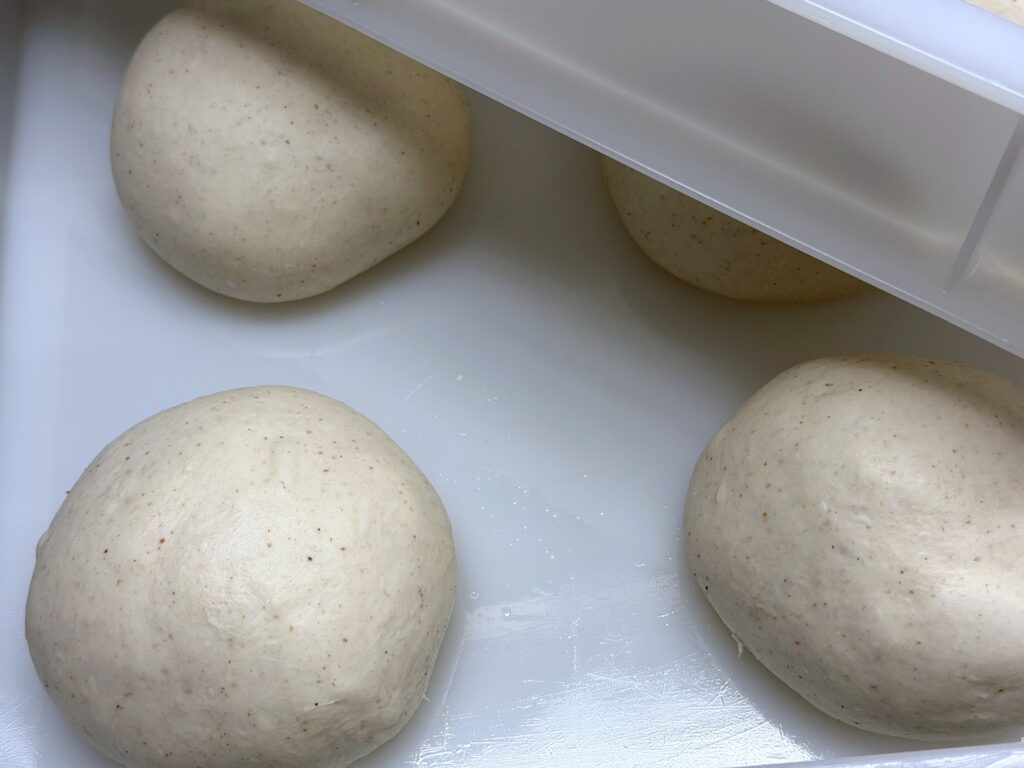
Recently I prepared a dough with Tipo 0 flour, the bag said “media forza con germe vitale di grano tenero”. After kneading and proofing, i.e. the time the dough rises, there were lots of small brown dots. My first thought: Did something go wrong?
🌾 What “con germe” means: flour with wheat germ
The dots are usually harmless, I already explained that in the article about brown dots in pizza dough. This is about the print on the bag itself: “Con germe di grano” means “with wheat germ”.
As an Austrian, you read “germe” and immediately think of yeast. It’s a plausible thought, but incorrect. There is no yeast in it. It refers to the germ in the wheat grain, not baking yeast or microorganisms. So you still need your yeast as usual.
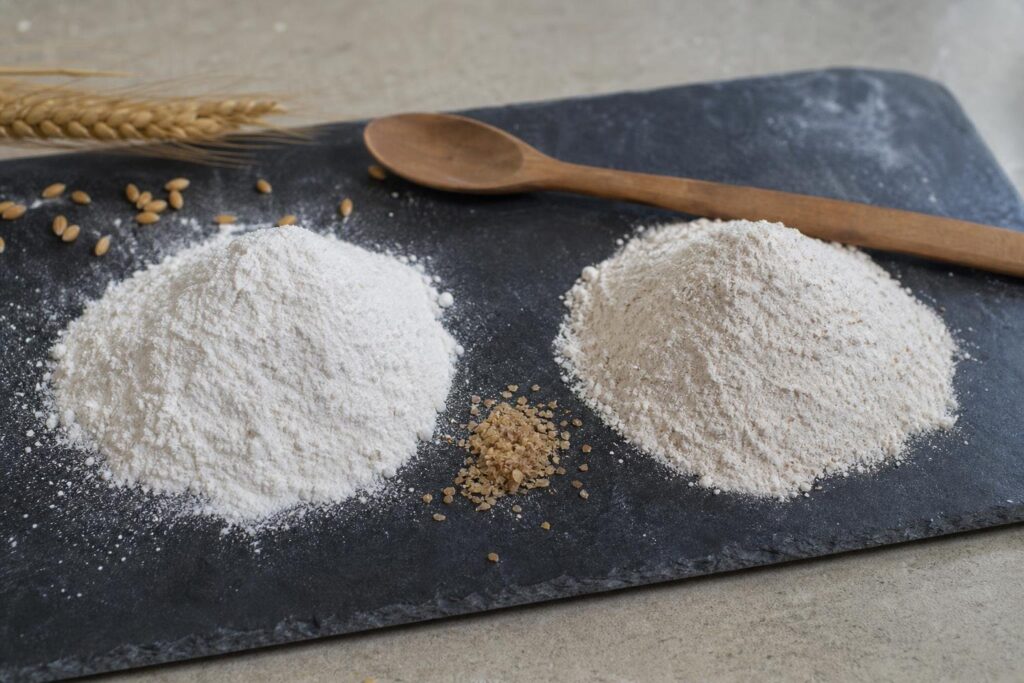
What are wheat germs actually? The germ is the embryo of the grain from which a new plant can grow. It is one of three components (well explained by the UK Flour Millers, in English):
- Endosperm: Also called the starchy endosperm. The largest part of the grain, mainly starch and protein. This is where light flours come from.
- Bran layers: The outer layers are called bran and contain a lot of fiber.
- Germ: Located at the bottom side of the grain and contains oil, protein, and micronutrients, among other things.
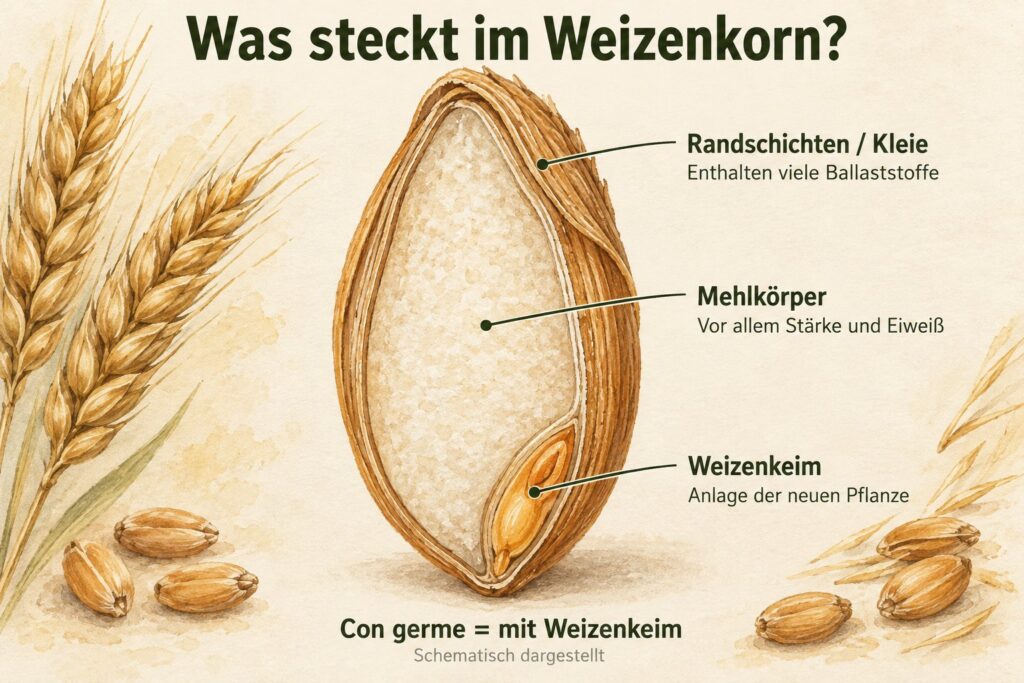
In light flours, the germ is largely separated. In a Con-Germe flour, it is included. How it is treated and how much of it ends up in the flour varies from product to product. For example, the ORO flours from Molini Pizzuti list 1% wheat germ in the ingredients. For 1 kg of flour, that’s just 10 g.
🥣 With germ does not automatically mean whole grain
“Con germe” describes the germ, not the flour type. The type, “Tipo” on Italian bags, tells you how much of the grain is in the flour. Tipo 0 and Tipo 1 can both contain wheat germ.
Tipo 1 contains more of the outer layers of the grain than Tipo 00. However, it is still not whole grain. For that, Italian bags say “integrale”.
Light flour (e.g. Tipo 00)
Contains: mainly endosperm, germ and bran layers largely separated
Does not mean: The type says nothing about baking strength
Con-Germe flour
Contains: flour with wheat germ, composition and treatment depending on the product
Does not mean: automatically whole grain or particularly strong
Whole grain flour (“integrale”)
Contains: endosperm, germ and bran layers in the proportion of the whole grain
Does not mean: that it processes like light pizza flour
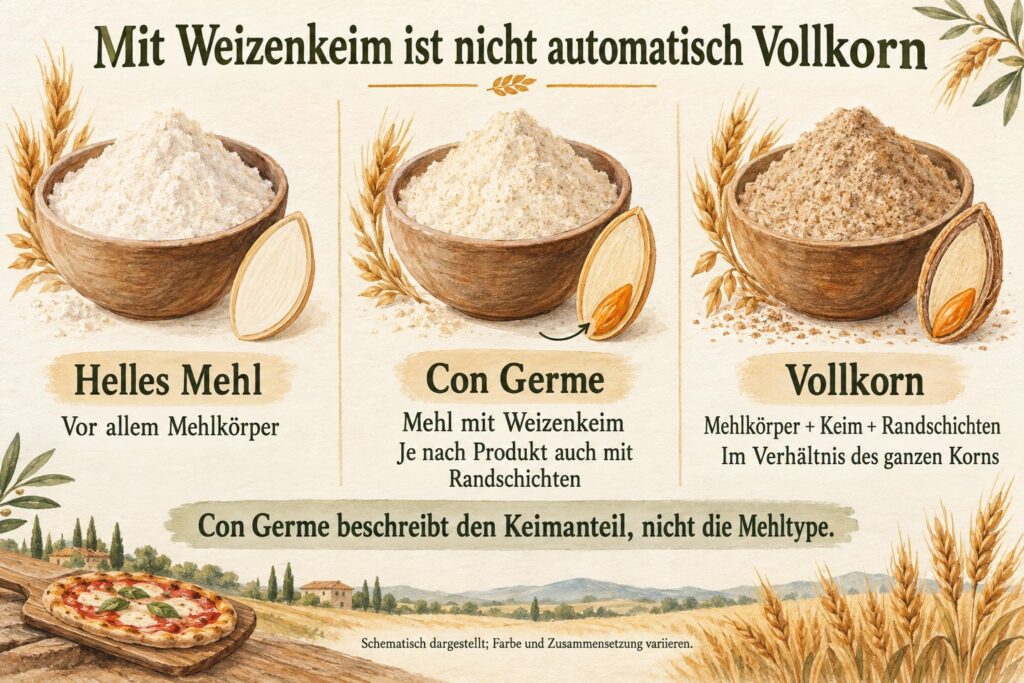
So if you are looking for whole grain flour for pizza, “con germe” alone is not enough. The germ does not replace the other grain components.
Another terminological trap: Under “wheat germ flour”, you will find pure, ground germ powder in stores, for example as a muesli additive. This is not pizza flour with germ. Different product, different purpose.
🌱 Germ, germinated, stabilized: do not confuse
On Italian bags, a few terms appear that are quickly lumped together. However, they do not belong together:
- Wheat germ: A component of the un-germinated grain.
- Germinated wheat, “grano germogliato”: The grain has already undergone a controlled germination process.
- Stabilized germ: Treated for better shelf life, for example with heat. Does not mean the grain has germinated.
- “Germe vitale”: A manufacturer’s designation. Do not equate with yeast, sourdough, or germinated grain.
A good example is Petra from Molino Quaglia. 5072 Più Vita is a Tipo 0 flour with stabilized, thermally treated, and according to the description, roasted wheat germ.
The HP line from the same manufacturer, on the other hand, uses germinated grains. Same manufacturer, two completely different concepts.
🍕 What the germ can change in your pizza dough
Honest answer upfront: You can’t tell from the print alone. Base flour, amount of germ, and how the germ was treated all play a role.
Taste: I like it, but no direct comparison yet
All mills advertise more flavor. Molini Pizzuti writes about the aroma of wheat germ, Dallagiovanna calls its germ flours a “concentrate of taste and aroma”, Piantoni also emphasizes the aroma of the germ. Petra describes a more aromatic, tender bite for 5072 due to the roasted germ.
I have already baked pizza with Nobilgrano from Dallagiovanna, with Pizzuti, and with Piantoni. I liked all three very much. By the way, we now have the flours from Molini Pizzuti in our shop.
What I haven’t done yet is a direct comparison. Direct, for me, means baking two pizzas side-by-side and tasting them at the same time. Only then can you really distinguish a difference cleanly.
Therefore, there is no “nutty” or “sweet” judgment here. Whether a taste difference comes from the germ or from the flour as a whole, I cannot say without this comparison.
Dough behavior: germ does not mean stronger
The germ contains, among other things, glutathione, a substance that can influence the cross-linking of gluten. Gluten is the protein structure in the dough that holds gases.
More germ therefore does not automatically mean more dough strength. How a flour behaves depends on which germ, with what treatment, is combined with which base flour.
An Italian study by Marti and colleagues (2014) has shown that it makes a difference in bread whether the germ was roasted or fermented. However, these were bread experiments. Nothing concrete can be predicted for your pizza from this.
A spoonful of germ powder from the health food store in your usual pizza flour is therefore not an equivalent substitute for a balanced Con-Germe flour. And no one can reliably tell you how much you should use.
Water: The data sheet is not a recipe
Hydration is the amount of water in relation to the amount of flour. With 1,000 g of flour and 600 g of water, that’s 60%. You can find more about this in the article on hydration at 60, 70, or 80%.
For flour with germ, there is no rule like “always use more water”. If your dough is already sticky, the germ label is no reason to add even more water next time.
⚠️Attention
“Water absorption: 56%” on the data sheet is a laboratory measurement at a defined dough consistency, not a recipe recommendation.
Calculated as a recipe, that would be 560 g of water per 1,000 g of flour. This results in a rather stiff dough. Conversely, the assumption “germ needs more water” can quickly make your dough too soft. The UK Flour Millers describe how this laboratory test works (in English, section “Water absorption”).
For the first attempt, I would change as little as possible at once. If you change the flour, water, and proofing time simultaneously, you won’t know afterward what made the difference. I described why consistency in flour is so important in Do you always need pizza flour?
💡Tip
For the first time, only change the flour. Keep the recipe, hydration, and times as usual. Look at the result and change only one thing on your next attempt.
Storage: check the specific label
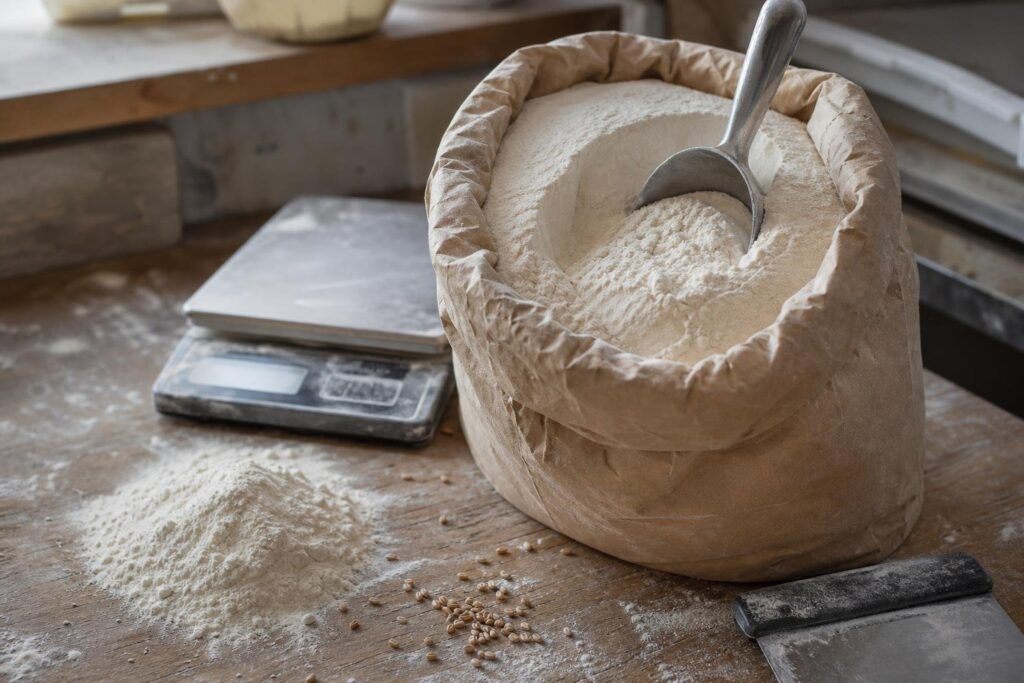
The germ contains oil. Enzymes and fat breakdown can affect shelf life. Stabilization through heat or fermentation slows down rancidity.
However, this does not mean that every flour with germ has a short shelf life. Several manufacturers state 12 months under their respective storage conditions. For your bag, the label and the best-before date (MHD) apply.
Close open flour well and store in a cool, dry, and dark place. Piantoni explicitly states below 25 °C in the data sheet for Luce di Grano 0 MD and recommends using it promptly after opening. If your flour smells rancid or musty, discard it.
Health: no shortcut to a healthier pizza
Wheat germ itself is nutrient-rich. However, this does not mean that a specific pizza becomes healthier or more digestible with it.
General claims about better digestibility, longer freshness, larger crust, or more water are not substantiated. None of these automatically follow from “germ included”.
📋 Con-Germe flours at a glance
Con Germe is not a separate flour class. You can see this from a few examples from the manufacturer’s product lines: different types, treatments, and strengths.
The W value is a measure of baking strength. A higher value indicates a stronger flour that can proof longer, not automatically a better one. “Führung” refers to the process and duration of dough resting.
Molini Pizzuti Pulcinella ORO
Type: Tipo 0 with wheat germ (1% according to the ingredients list)
W value: 260
Proofing according to manufacturer: 12–24 hours, direct (without pre-dough)
Source: Manufacturer’s page Molini Pizzuti
🛒 View in PizzaLadenMolini Pizzuti Costa d’Amalfi ORO
Type: Tipo 0 with wheat germ (1% according to the ingredients list)
W value: 300
Proofing according to manufacturer: 24–48 hours
Source: Manufacturer’s page Molini Pizzuti
🛒 View in PizzaLadenMolini Pizzuti Tipo 1 ORO
Type: Tipo 1 with wheat germ (1% according to the ingredients list)
W value: 300
Proofing according to manufacturer: 24–48 hours
Source: Manufacturer’s page Molini Pizzuti
🛒 View in PizzaLadenMolino Piantoni Luce di Grano
Type: Tipo 0 with wheat germ flour, three variants:
- RP: W 200–230, short proofing
- MD: W 280–310, medium to long
- LG: W 370–390, long proofing
Molino Dallagiovanna Nobilgrano
Type: Tipo 0 or Tipo 1; germ is separated, cold-stabilized, and re-added
- E Rosa: W 210, up to 6–7 h at room temperature
- N Blu: W 290, up to 10 h at room temperature
- R Verde: W 340, up to 12 h at room temperature
Longer when refrigerated.
Sources: Dallagiovanna Pizza flours, Germ process
Petra 5072 Più Vita
Type: Tipo 0 with stabilized, roasted germ
W value: 320–340
According to manufacturer’s guidance: medium to long
Source: Petra Manufacturer Shop
Caputo Type 1
Type: Type 1 with naturally present germ and bran
W value: 250–270 (1 kg pack)
Attention: not a pure germ comparison, as bran is also included
Source: Mulino Caputo Manufacturer Page
🛒 View in PizzaLadenThe time indications are not complete recipes. Without temperature, you cannot simply transfer “24 hours” to your dough. How time and temperature interact is explained in Pizza dough rising: 24, 48 or 72 hours?
Caputo Type 1 is also not a pure germ comparison, as it also contains bran. Caputo does not have its own “Con Germe” line.
Interesting with Pizzuti: Pulcinella and Costa d’Amalfi are available both with and without germ. According to the data sheet, Pulcinella and Pulcinella ORO have the same values (W 260, P/L 0.65, water absorption 56%). The difference is in the ingredients list: the ORO has an additional 1% wheat germ.
This means for you: read the name on the bag carefully. A missing “ORO” is a different flour.
💡Tip
Label check in five points:
- “Con germe”, “germe di grano”, “germe vitale”: Germ included.
- “Germogliato”: Sprouted grain, different concept.
- Tipo 00, 0, 1 or integrale: Indication of milling; integrale means whole grain.
- W value: Indication of baking strength and possible rising time, not a complete time specification.
- Best before date and storage instructions: Observe for this specific bag.
❓ Frequently asked questions
Does Con-Germe flour contain yeast?
No. “Germe” here refers to the wheat germ, not yeast. You still need the yeast for your recipe.
Is flour with wheat germ whole grain?
Not automatically; even a Tipo 0 can contain wheat germ. Whole grain flour contains the endosperm, germ, and bran layers in the proportion of the whole grain; the bag will say “integrale”.
Do I need more water with Con-Germe flour?
There is no general rule for this. Start with your usual hydration and do not use the water absorption in the data sheet as a recipe guideline.
Does flour with wheat germ go rancid faster?
The oil in the germ can affect shelf life; stabilization slows down rancidity. How long your flour lasts depends on the product and storage. Check the label and best-before date and do not use flour that smells rancid or musty.
🔬 How it continues for me
My everyday flour so far is a light Tipo 00 without germ, the La Napoletana by Dallagiovanna. The direct comparison is still pending, and I already know what I’ll use for it: Pulcinella against Pulcinella ORO. Same data sheet values, with 1% germ added to one. You can hardly get closer to a pure germ test with commercial flours.
Both pizzas will come out of the oven side by side and be tasted at the same time. First with exactly the same handling, then each as it suits it best. A single uniform procedure tends to disadvantage one of the two flours.
Until then, I won’t offer any “nutty” or “more aromatic” comparisons. I’ll only write that once both pizzas have been on the table side by side.
Those who find out how it turns out first are the people in my newsletter.
