



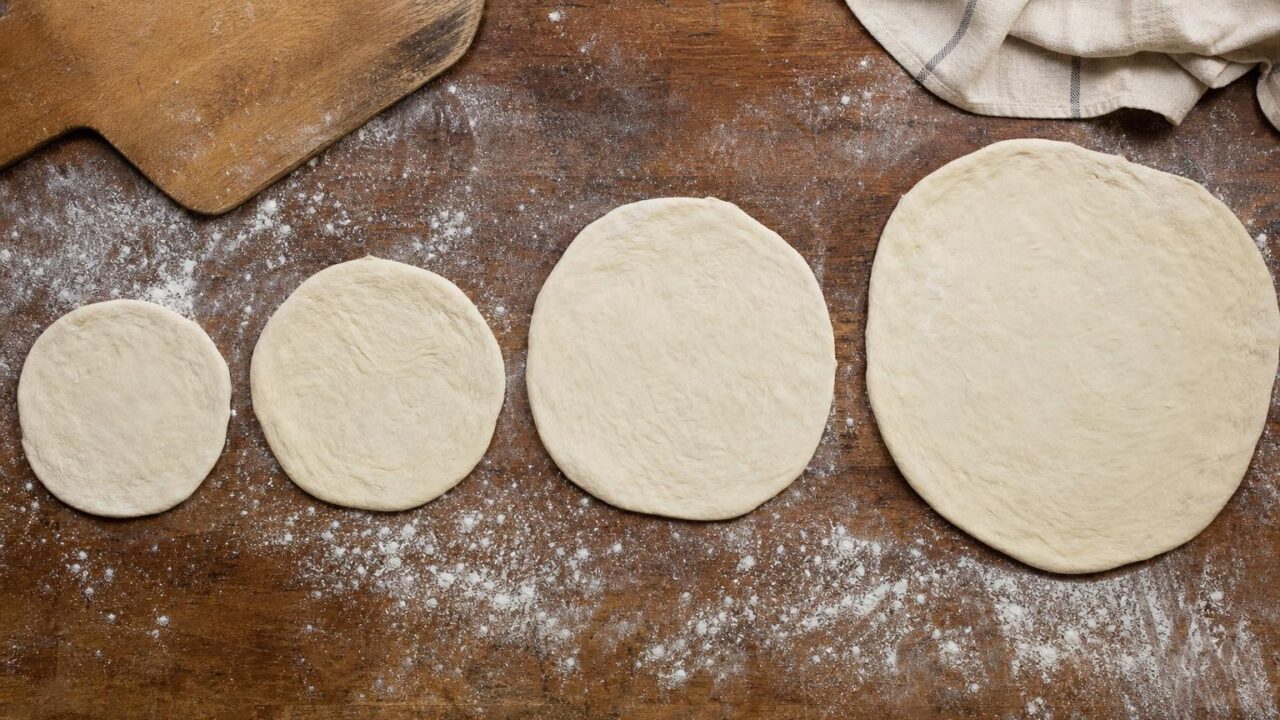
Five dough balls cleanly formed from one kilo of flour, equal weight and neat – there isn’t enough dough left for a sixth, and the last pizza ends up paper-thin. Another time, the opposite happens: balls are formed too large, and the crust becomes thick and bready instead of crispy. I’ve messed both up myself before realizing: dough ball weight isn’t a gut feeling thing, it’s a calculation.
And the answer to the question “how much dough for one pizza” isn’t that complicated – if you know what matters.
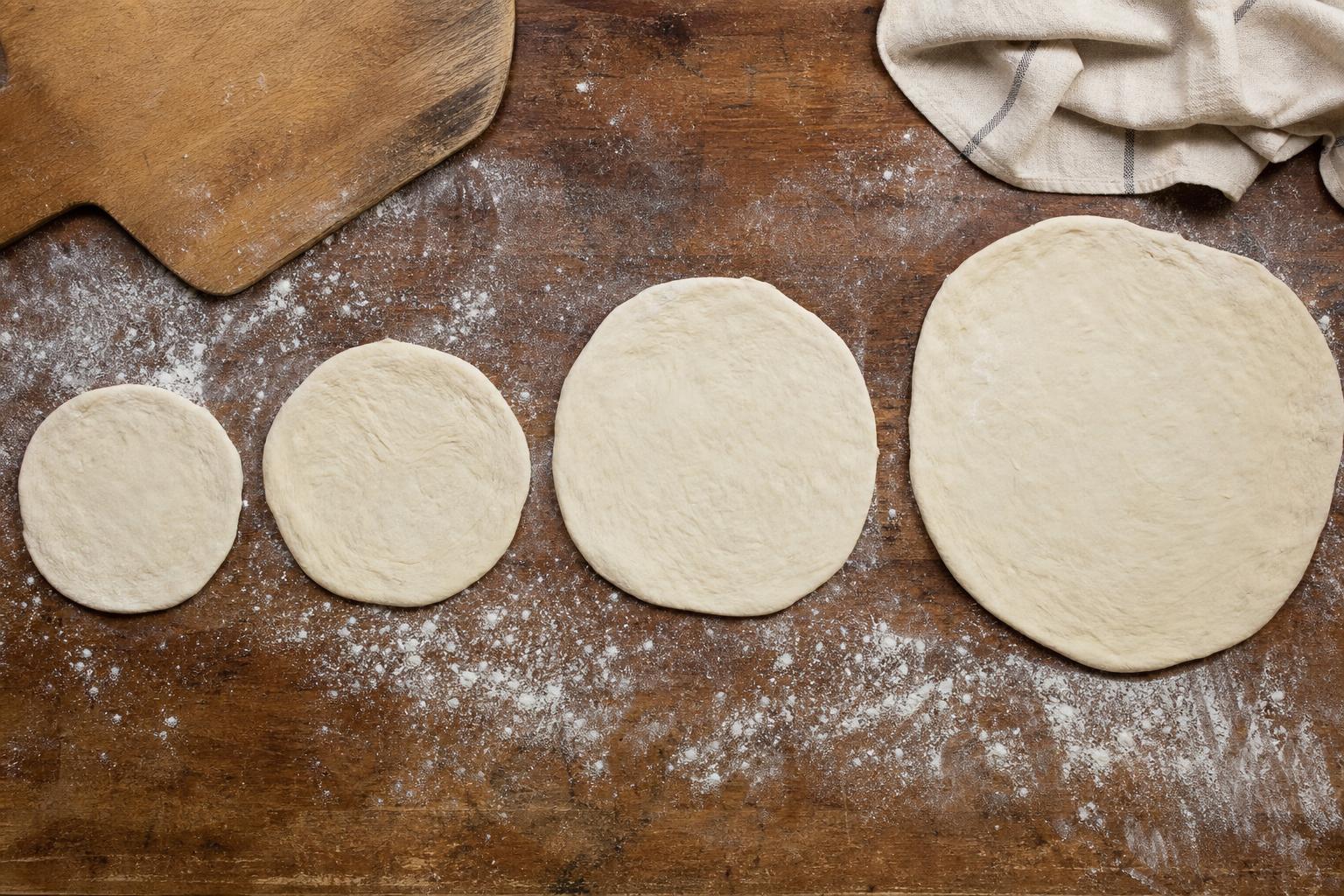
How much dough for one pizza? The rule of thumb
For those in a hurry, here’s the short version. Everything after this is the long version with the details that make the difference.
| Pizza style | Dough ball weight | Size |
|---|---|---|
| Neapolitan | 270–290 g | Ø 33 cm |
| Roman (Tonda) | 180–220 g | Ø 30–32 cm, thin & crispy |
| New York Style | 280–350 g | Ø 35–40 cm |
| Pizza in Teglia | approx. 750 g | Tray approx. 30×40 cm |
| Focaccia | 800–900 g | Tray approx. 30×40 cm |
| Sicilian / Detroit | 500–700 g | depending on pan size |
These are guidelines, not dogma. Your oven, your desired size, and your taste ultimately play a role too.
Why a larger pizza doesn’t just need “a bit more” dough
If you double the diameter of your pizza, you don’t need twice as much dough. You need approximately four times as much.
The reason: dough scales with area, not diameter. A pizza with a 20 cm diameter has an area of about 314 cm². A pizza with a 40 cm diameter – double the diameter – doesn’t have double the area, but with about 1,256 cm², it has four times the area. And therefore, approximately four times the amount of dough, if the thickness is to remain the same.
This is where most people misjudge. “A bit bigger” feels harmless by eye, but mathematically it’s often a third more dough or even more.
For everyday use, you don’t need a formula in your head – just a known starting size. A mental math trap right away: Because the area grows quadratically with the diameter (see above), you **cannot** simply calculate “diameter times grams per centimeter from zero” – 36 cm × 16 g would be 576 g, far too much. What works: calculating in small steps from a pizza size whose weight you know. As a rule of thumb in the typical home oven range (28–36 cm): **approx. 15–17 g more dough per centimeter more diameter** – starting from my own Neapolitan (280 g for 33 cm, my standard size), it looks like this, each line shows the increase from the line *before*, not from zero:
| Diameter | Dough ball weight | Increase from previous step |
|---|---|---|
| 28 cm | approx. 200 g | – |
| 30 cm | approx. 230 g | +30 g (15 g/cm) |
| 33 cm | 280 g | +50 g (17 g/cm) |
| 36 cm | approx. 330 g | +50 g (17 g/cm) |
Two or three centimeters more diameter seem harmless when stretching – but that’s already 30–50 g more dough, added to the size you’re starting from. Exactly the difference that suddenly makes a dough ball not enough for the oven or pizza stone.
🍕 Dough ball weight by style in detail
Neapolitan
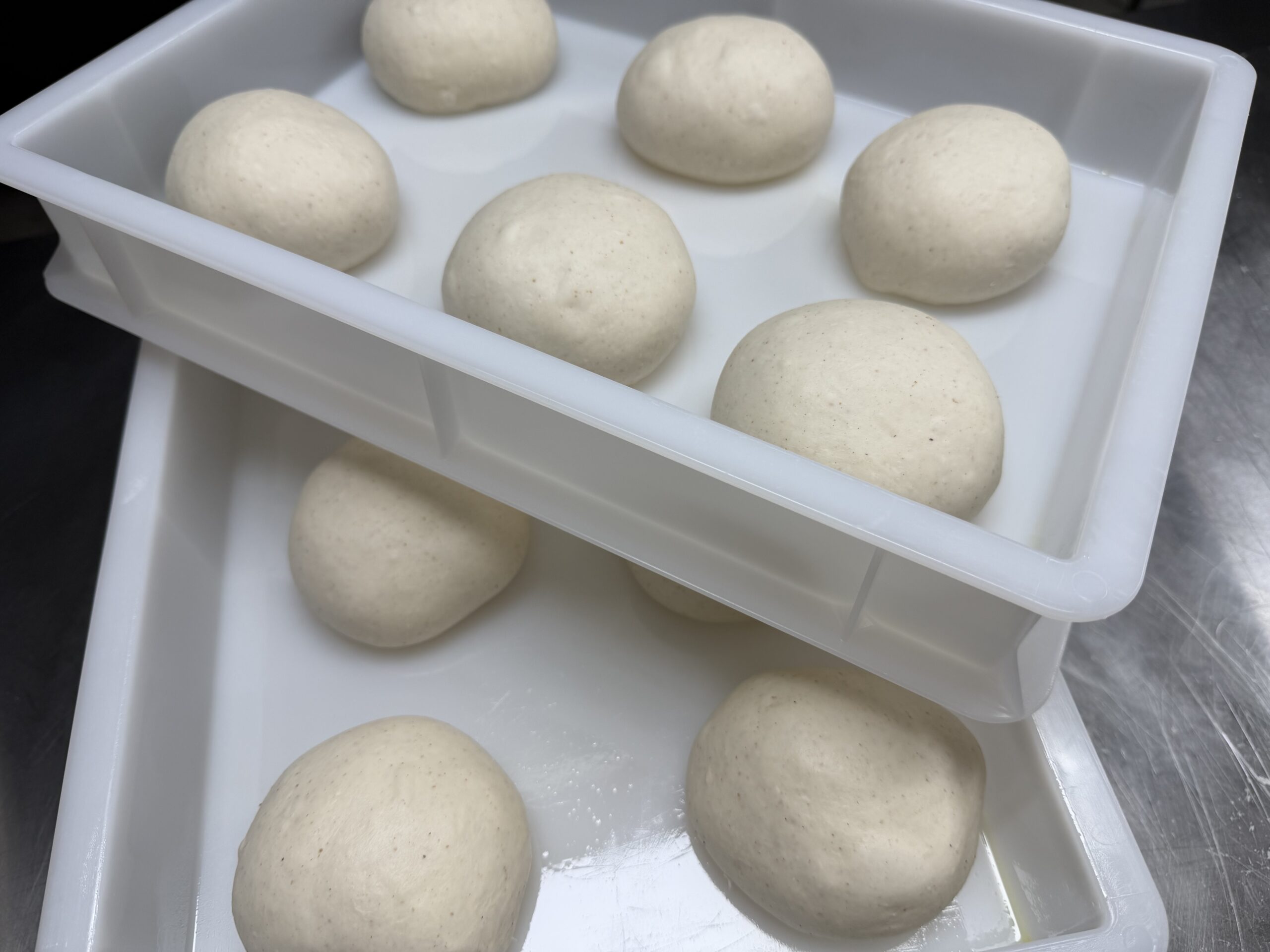
The AVPN (the Neapolitan pizza association that defines the official standard) specifies 200–280 g. In my basic recipe for Neapolitan pizza dough, with 1 kg of flour, I end up with six dough balls of 270–290 g each for a Ø 33 cm pizza – this is the range where the cornicione (the puffed-up crust) rises nicely without the center becoming too thick.
Smaller than 250 g quickly becomes paper-thin at this size and tears when stretching. Larger than 300 g often makes the crust too bready for the classic style.
Roman (Tonda Romana)
If you like the crispy, thin Roman pizza, use noticeably less dough: 180–220 g is enough for a pizza that cracks rather than chews. Logically, when you consider that a thin crust is the goal here, not a puffed-up crust.
New York Style
New York pizzas are larger (Ø 35–40 cm) and should be foldable without tearing. This requires more dough per area than for Neapolitan: 280–350 g. A simple rule of thumb from the US pizza world: about 22 g of dough per inch (2.5 cm) of diameter.
Teglia, al taglio & Focaccia
Here, it’s calculated by the tray rather than by the ball. In my recipe for al taglio, Teglia, and Focaccia from one dough, I use around 750 g of dough for a tray of approx. 30×40 cm – for Focaccia, I deliberately increase it to 800–850 g because the thicker, airier crumb needs more volume.
Sicilian / Detroit
Thick pan base, lots of crumb: 500–700 g of dough depending on pan size is normal here. Anyone coming from the Neapolitan way of thinking is almost always shocked when weighing it for the first time – this is intentional.
Crust tears when stretching or the center has a hole? The dough ball was probably too small for your target size. Crust remains tough and raw in the center, even though everything is already dark on the outside? The opposite case – too much dough for the pizza size or oven temperature. Neither is a dough problem, but a quantity problem. Fix: next time, orient yourself by the target weight from the table above and check with a scale instead of dividing by feel.
📐 How many pizzas do I get from 1 kg of flour?
This is the calculation that actually underlies every dough ball weight – and it’s rarely calculated anywhere. The trick: You have to count not just the flour, but the whole dough. Flour plus water plus salt plus the pinch of yeast.
Let’s take my own basic recipe: 1,000 g flour, 620 g water (62% hydration, i.e., water content relative to flour), 30 g salt, 2 g fresh yeast. That makes a total of 1,652 g of finished dough. Divided by six dough balls, that’s 275 g each – exactly in my usual range.
And now the part you’re actually interested in: **The larger the dough balls, the fewer pizzas you get from one kilo of flour – and conversely, smaller dough balls stretch your flour much further.** With the same hydration of 62% (i.e., 1,652 g total dough from 1 kg flour), it looks like this:
| Dough ball weight | Pizzas from 1 kg flour |
|---|---|
| 200 g | approx. 8 pizzas |
| 250 g | approx. 6–7 pizzas |
| 280 g | approx. 5–6 pizzas |
| 320 g | approx. 5 pizzas |
| 350 g | approx. 4–5 pizzas |
| 750 g (Teglia tray) | approx. 2 trays |
If you want smaller children’s pizzas for a larger group, you suddenly get two more pizzas out of the same bag of flour. If you want New York-sized flatbreads, it gets tight – and you need more flour than you might have planned.
By the way, the amount of water you add also changes the calculation – with more hydration, 1 kg of flour yields more total dough. If you’re still unsure about hydration, I’ve written a separate guide to 60%, 70%, and 80% hydration.
The calculator above is a good first estimate – but in practice, flour plus water plus salt plus yeast never adds up to the exact total amount. A little dough always sticks to the bowl, a little to your hands, a little to the kneading hook. That’s why I don’t rely on adding up the ingredients, but weigh the finished kneaded dough directly before it goes into the bulk fermentation. That’s the number that’s really accurate – and then I divide it by the number of dough balls, not the theory above.
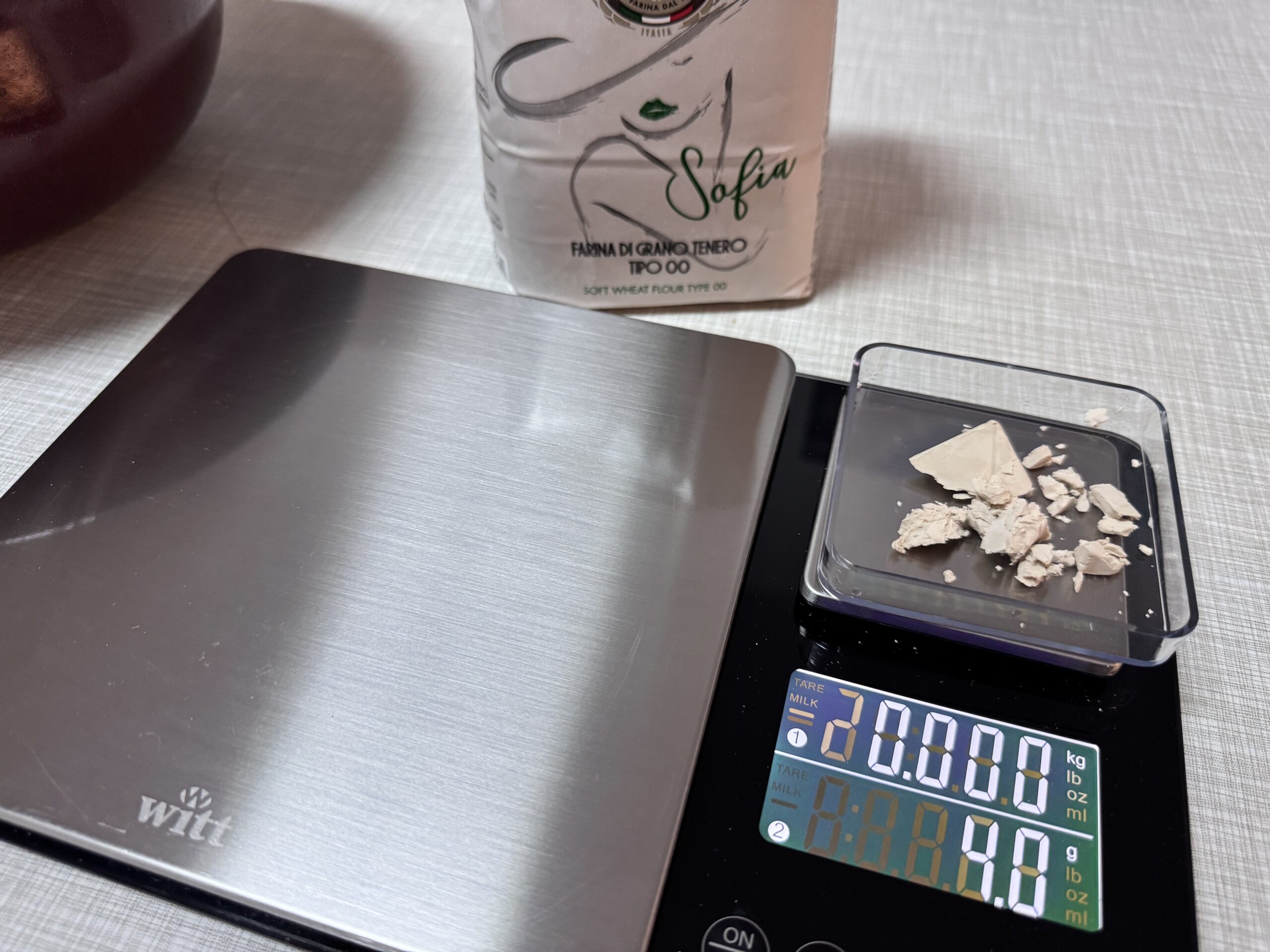
With dough ball weight, even 10–20 g can make the difference in the final result – guesswork isn’t enough here. I weigh each dough ball individually, even after ten years.
⚖️ Witt Pizza Scale DUAL (2 Zones) 📦 Pizza Dough Box Set 40×30 cmIn the end, dough ball weight isn’t a rulebook you have to memorize. It’s simply the point where you decide: How many pizzas do you want to get from your flour, and what should each individual pizza look like? You can’t have both perfectly – but now at least you know which lever to pull.
What dough ball weight do you bake? Write it in the comments or in our PizzaLiebhaber-Österreich group on Facebook – I’m curious if my 270 g is an outlier or mainstream.
Klausi 🍕
