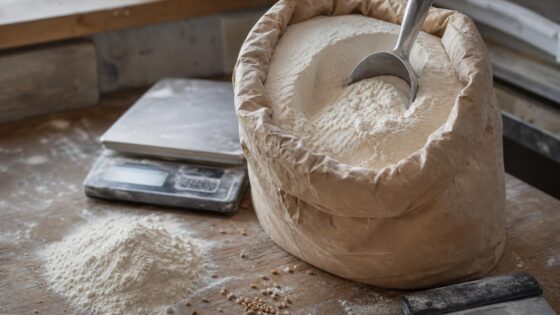




It’s happened before: flour halved, forgot to halve the water. What ended up in the bowl was flour soup instead of pizza dough.
Yes, you can halve a pizza dough recipe. But then really every ingredient.
📋 Pizza dough with 500 g flour: the recipe, already worked out
If you don’t feel like doing the maths: this is my basic recipe for Neapolitan pizza dough, converted to 500 g flour. Enough for three 33 cm pizzas.
- 500 g Tipo 00 pizza flour
- 310 g water, ice-cold
- 15 g sea salt
- 1 g fresh yeast
- Semola (durum wheat semolina) for stretching
And this is how it becomes a dough:
- Dissolve the salt in the water.
- Stir in about 75 g of the flour.
- Add the fresh yeast and mix it in.
- Work in the rest of the flour bit by bit. The dough is sticky at first, that’s how it should be.
- Knead on the work surface for 15 to 20 minutes until smooth.
- Let it rest for 5 to 10 minutes. Then Stretch and Fold: lift the dough and lay it over itself until the surface is smooth.
- Let it rise, covered, in a lightly oiled bowl for about 2 hours at room temperature.
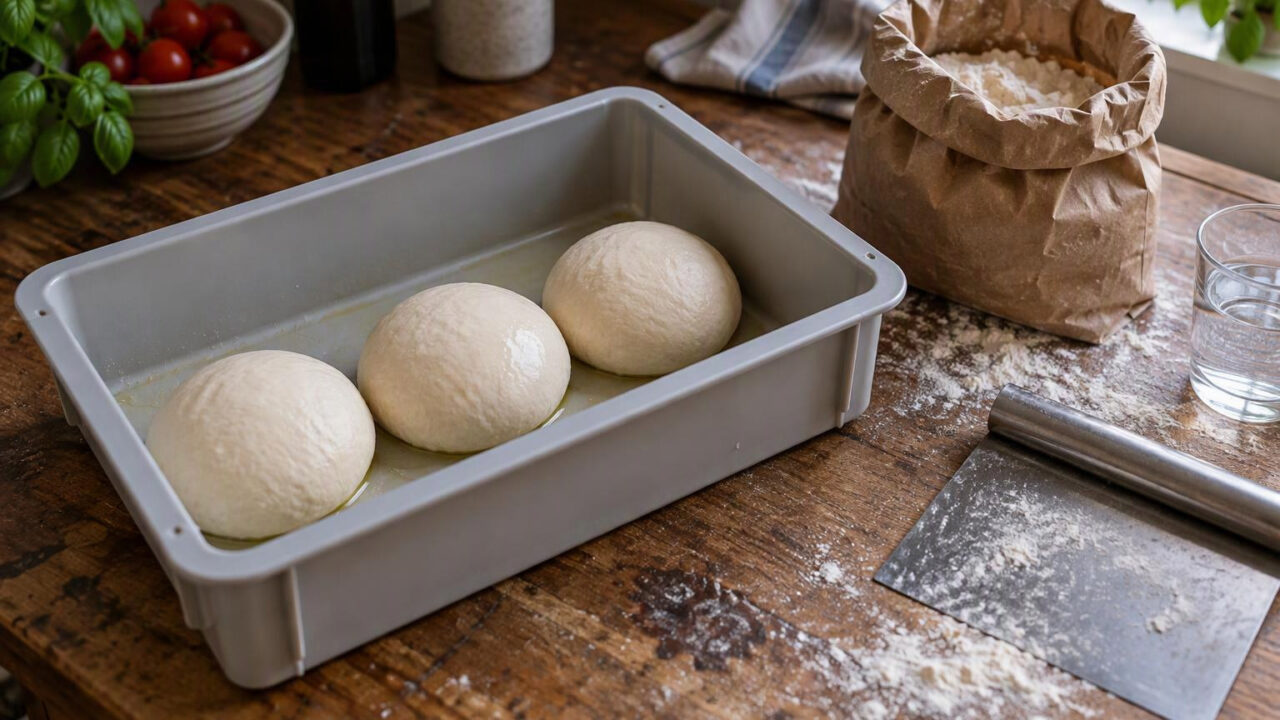
- Shape three balls, put them in an oiled box with a lid and leave them in the fridge at about 6 °C for 20 to 44 hours.
- Take them out at least 2 hours before baking. Depending on room temperature, 3 to 4 hours is fine too.
That gives you about 825 g of dough, so three dough balls of 275 g each. Dough balls are the individual portions of dough for your pizzas. How weight and size are connected is explained in the article How much dough for one pizza? I’ve described stretching and baking in detail in the basic recipe.
⏱️ What you don’t halve when halving
You only halve what goes on the scale: flour, water, salt and fresh yeast. Everything else stays as it is.
I’m spelling this out because that’s exactly where the uncertainty comes from. Half the dough, so only ten minutes of kneading and half a day in the fridge? Nope.
- Kneading time: 15 to 20 minutes by hand, even with 500 g flour.
- Rising times: about 2 hours at room temperature, then 20 to 44 hours in the fridge.
- Before baking: let them come to room temperature for 2 to 4 hours.
- Weight per dough ball: 270 to 290 g. You get fewer balls, not smaller ones.
- Baking temperature and baking time: same as the full recipe.
If your kitchen is very warm or very cool, the rising time can shift a bit. But that’s down to room temperature and applies to the full recipe just the same.
💡Halve: yes or no
Halve: flour, water, salt, fresh yeast
Don’t halve: kneading time, rising times, dough ball weight, baking time
🧮 Two, four or twelve pizzas: the quantities
My basic recipe is 1 kg Tipo 00 pizza flour, 620 g ice-cold water, 30 g sea salt and 2 g fresh yeast. That makes about 1,650 g of dough for six dough balls.
500 g flour is half of that and makes three pizzas, not two. For two pizzas you need a third of the basic recipe.
2 pizzas · 333 g flour
Water: 207 g
Salt: 10 g
Fresh yeast: 0.7 g
3 pizzas · 500 g flour
Water: 310 g
Salt: 15 g
Fresh yeast: 1 g
4 pizzas · 667 g flour
Water: 413 g
Salt: 20 g
Fresh yeast: 1.3 g
6 pizzas · 1 kg flour
Water: 620 g
Salt: 30 g
Fresh yeast: 2 g
12 pizzas · 2 kg flour
Water: 1,240 g
Salt: 60 g
Fresh yeast: 4 g
For me, pizza dough for 2 people means two pizzas, so 333 g flour. With 500 g you’ve got a third one in reserve. For 4 people, use the card with four pizzas.
If your amount is somewhere in between, the calculator works it out for you. Enter either the number of pizzas or the flour you’ve got at home.
🧮Dough calculator
💡How to work out any amount
Baker’s percentages always refer to the flour. The flour is the base at 100 %.
- Water: 62 % of the flour
- Salt: 3 % of the flour
- Fresh yeast: 0.2 % of the flour
For 800 g flour that means: 800 × 0.62 = 496 g water, 800 × 0.03 = 24 g salt, 800 × 0.002 = 1.6 g fresh yeast.
🤔 Only 1 g fresh yeast for 500 g flour? Yes, really
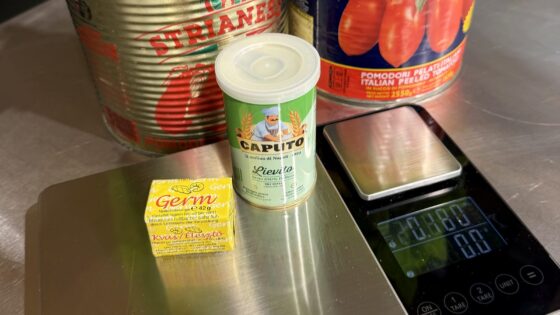
Next to the quick recipes online, 1 g looks like a typo. They often call for half a cube of fresh yeast for 500 g flour, sometimes a whole one. A cube is 42 g.
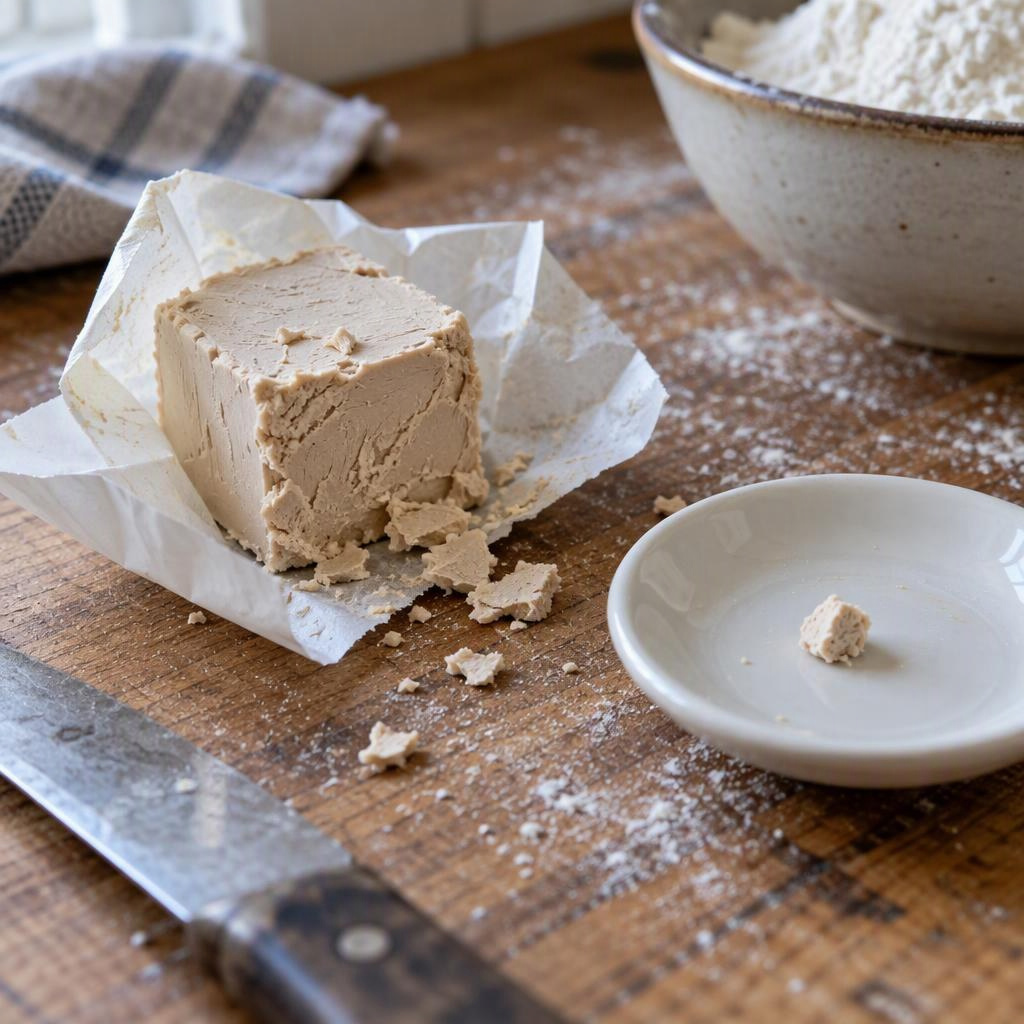
Both are right, because the amount of yeast depends on the rising time, not just on the flour. A quick recipe lets the dough rise for about an hour. That takes a lot of yeast.
My dough has time: about 2 hours at room temperature, then 20 to 44 hours in the fridge. A little yeast works slowly. The dough can rest longer and gets a better texture and more flavour as a result.
You can see it in my own recipes too. The 8-hour dough gets 4 g fresh yeast per 1 kg flour, so 2 g for 500 g. Twice as much, because it only has 8 hours.
If you don’t trust that one gram and add more just to be safe, but still put the dough in the fridge for a day, you’ll end up with over-proofed dough. It has simply gone too far. You don’t need to throw it away though, it still makes bread from pizza dough.
⚠️Don’t round up the yeast
Amount of yeast and rising time go together. Only use more yeast if the dough is supposed to rise for a shorter time.
⚖️ How to weigh 1 g of fresh yeast
I always weigh yeast, never go by feel. But with such small amounts a normal kitchen scale reaches its limit. If it only shows 1 g steps, it can’t weigh 0.7 g or 1 g accurately.
So first check what steps your scale actually measures in. In our shop we’ve got the Witt pizza scale DUAL for that, with two platforms. The big one weighs up to 10 kg accurate to 1 g, for flour and water. The small one weighs up to 1 kg accurate to 0.1 g, for yeast and salt.
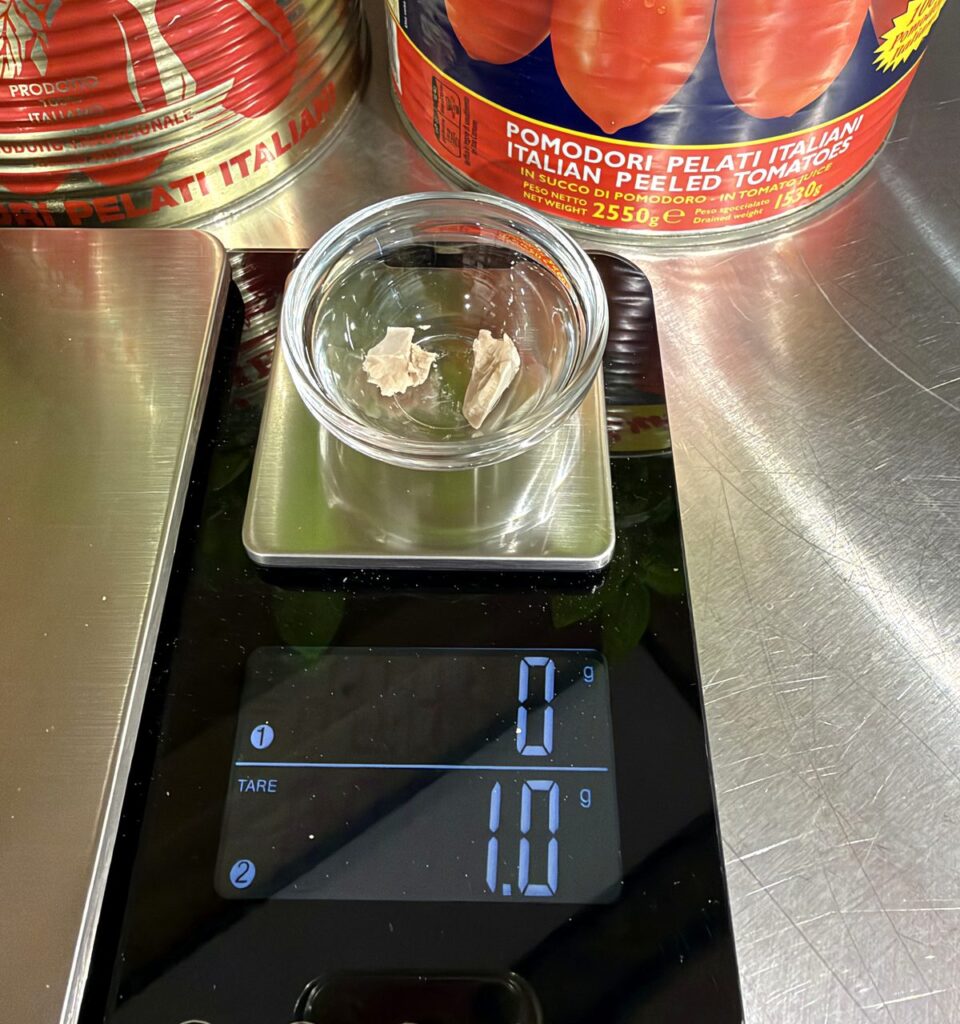
No precision scale: yeast water
If you don’t have a precision scale, a bit of maths still gets you to 1 g. You weigh out a larger amount of yeast, dissolve it in water and only use part of it.
- Dissolve 10 g fresh yeast in 90 g water. That’s 100 g of yeast water.
- Add 10 g of it to the dough. That contains 1 g yeast and 9 g water.
- Subtract the 9 g from the rest of the water: 301 g instead of 310 g.
For two pizzas with 0.7 g yeast, use 7 g of yeast water. Pour the rest away, a cube doesn’t cost the earth.
A normal kitchen scale can handle 10 g reasonably well, 1 g it can’t. “Pea-sized” or “a pinch” won’t help you either, there’s no reliable gram figure for that. The cleaner solution is still a scale with 0.1 g.
This is only about fresh yeast. Dry yeast is dosed differently, there’s a separate article coming on the different types of yeast.
🥣 Where converting goes wrong
Renate asked under my basic recipe: “Can I halve the recipe?” Yes. You don’t need a separate recipe or a different composition for that.
The trap is that you only catch some of the ingredients. 1 kg flour becomes 500 g, but the 620 g water stays stuck in your head. That’s exactly how the flour soup from the start happens.
With salt you only notice the mistake on your plate. 30 g for 500 g flour is double the amount.
My tip is unspectacular: write down the converted amounts beforehand. Don’t halve things in your head with the open bag of flour in your hand.
⚠️Before you get started
- Convert every ingredient, including salt and yeast.
- Weigh everything in grams, including the water.
- Write down the amounts and tick them off as you add them.
🫠 Calculated correctly and the dough is still sticky
Theresa wrote under the recipe that she made half, 500 g flour and 310 g water, and the dough was completely runny. Her maths was right. 310 g for 500 g is exactly 62 % hydration, meaning water in relation to flour.
It wasn’t the maths. If a dough like that still turns runny, something happened while weighing. What exactly, I don’t know, and guessing won’t get us anywhere.
What I asked her: which flour was it? Not every flour absorbs the same amount of water. With a weaker flour or a classic all-purpose flour, the same dough gets much stickier and harder to work with than with a good pizza flour.
It’s allowed to be sticky at the start anyway, especially if you knead by hand. Give it a few minutes’ rest after mixing so the flour can absorb the water. After that it usually goes much better and it gets smoother as you knead.
In the end Theresa used a whole kilo of flour. Understandable, but from then on nothing adds up anymore: suddenly there’s too little water, and the salt and yeast don’t match either.
💡If it’s sticky
- Check the flour. All-purpose flour handles less water than pizza flour.
- Let it rest a few minutes, then keep kneading.
- Don’t add more flour. Otherwise you’ll have to recalculate the whole recipe.
❄️ Just one pizza? Make more dough anyway
For a single pizza it would be 167 g flour, 103 g water, 5 g salt and 0.3 g fresh yeast. That’s hardly possible to weigh accurately.
Better to make the 500 g and use up what’s left over. Freezing works: in portions and airtight, as long as the dough ball is still in good shape. To thaw, it goes in the fridge overnight and then gets to relax at room temperature before you stretch it.
Or you bake something else with it. Leftover dough turns into grissini or mini ciabatta.
🔥 Why big doughs need less yeast
For my big workshop doughs I usually use a bit less yeast per kilo of flour. For 10 kg flour I use about 15 g. If the dough needs to rise faster, I use 18 g.
Scaled up strictly from the basic recipe, it would be 20 g. So overall the big dough has more yeast than the small one. It’s only the amount per kilo of flour that goes down.
Behind it is the mass effect. Didier Rosada of the San Francisco Baking Institute describes it in a technical article on dough strength from 2004: in a larger mass of dough the processes run faster, because conditions for the microorganisms are more favourable, temperature among them.
Rosada names small doughs up to about 2.7 kg, which tend to ferment longer, and large ones from about 22.7 kg, which tend to ferment shorter. Those are kilos of finished dough, not kilos of flour.
He adjusts the fermentation time, meaning the time in which the dough rises. I keep the time the same and use less yeast per kilo. Both compensate for the same effect.
There’s no fixed formula for it. With the big amounts I go by feel these days. I still weigh everything though.
💡For your dough at home
A dough with 500 g or 1 kg flour is small. If you halve, you halve the yeast too. The mass effect only matters once you mix several kilos of flour at once for a big crowd.
For fermentation in the fridge I always use between 1.5 and 2 g fresh yeast per 1 kg flour. If the dough sits in the cold room at 4 degrees, I add a bit more, because the yeast barely works there. I don’t have a gram figure for that.
Frequently asked questions
Can I simply halve a pizza dough recipe?
Yes. Halve every ingredient: flour, water, salt and fresh yeast. Kneading time, rising times and the weight per dough ball stay the same.
How much water, salt and fresh yeast for 500 g flour?
Going by my basic recipe, 310 g water, 15 g salt and 1 g fresh yeast, with about 20 hours in the fridge. That’s exactly half the amounts for 1 kg flour.
How many pizzas do I get from 500 g flour?
Three 33 cm pizzas. 500 g flour makes about 825 g of dough, that’s three dough balls of 275 g each.
Why does the dough only get 1 g fresh yeast when other recipes use half a cube?
Because the amount of yeast depends on the rising time. Recipes with lots of yeast rise for about an hour. My dough rises for about 2 hours at room temperature and then 20 to 44 hours in the fridge, so a little yeast is enough.
How much flour do I need for 2 pizzas?
For two 33 cm pizzas I count on 333 g flour, 207 g water, 10 g salt and 0.7 g fresh yeast. That’s a third of the basic recipe.
Does the dough need to rise for less time if I make less?
No. With household amounts, the process stays the same. Only with very large masses of dough does fermentation run noticeably faster.
Can I double the recipe too?
Yes, for 2 kg flour you double all the ingredients. Only with much larger amounts do I use a bit less yeast per kilo of flour, for 10 kg for example about 15 g instead of 20 g.
By the way, this article came out of Renate’s question. I answer a question like that every week in the newsletter, and you can send me yours too.
My basic Neapolitan recipe scaled to 500 g flour: 62% water, 1 g fresh yeast and about 20 hours in the fridge. Makes three dough balls for 33 cm pizzas.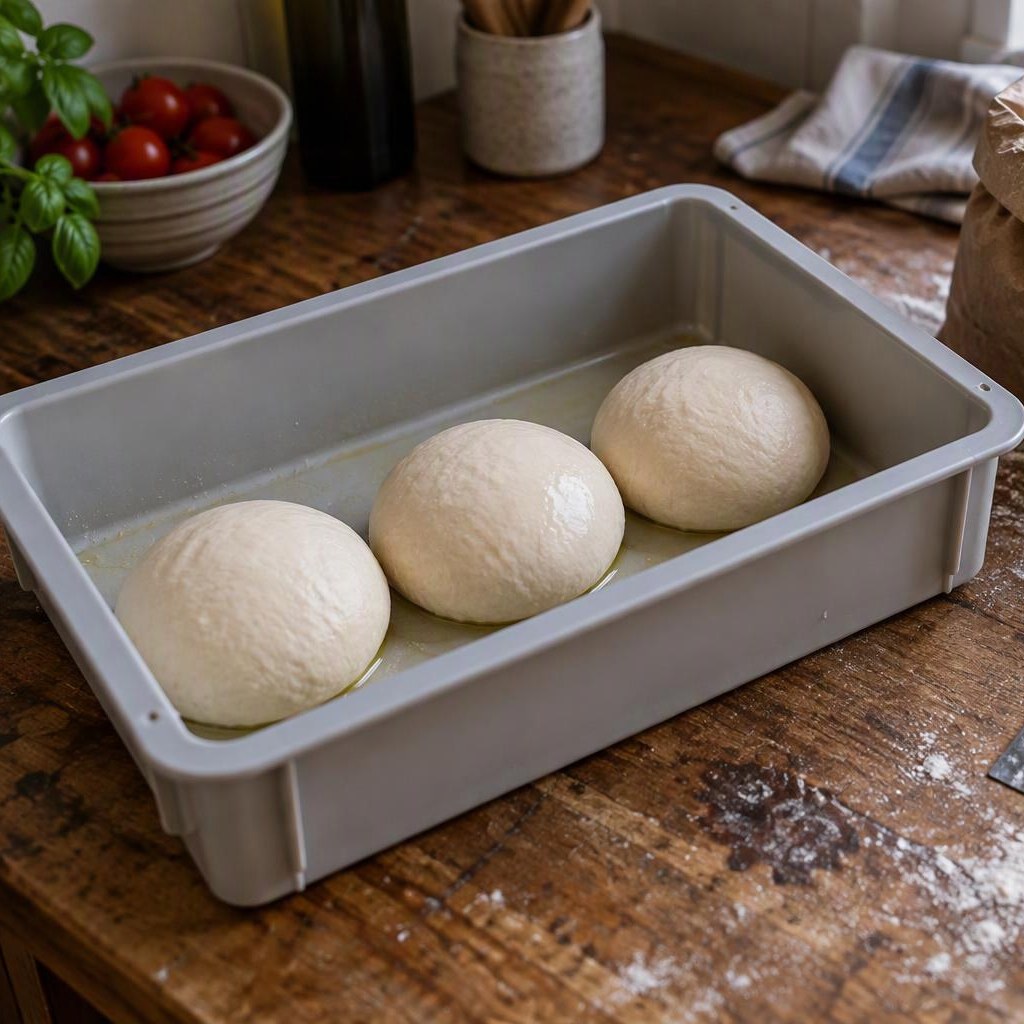
Pizza Dough with 500 g Flour (3 Pizzas)
Ingredients
Method